Categories
Blog

Aspects of SEO That a Content Writer Needs to Be Familiar With

If you’re a content writer, you’re probably aware of the ever-increasing need to improve your SEO content writing skills. SEO is virtually a science, but it’s also a modern-day art form.

As an SEO writer, your job is to keep your mind open, research new trends, and find the best way to please your biggest fans – your readers and search engines like Google. 

However, what works for readers may not work for Google and vice versa. So, the trick is to develop a unique style that can satisfy both your target audience and the most popular search engines in the world.

Just as you need to feel the pulse of your audience to produce the best content that’s a real treat for their needs, you should do the same for search engines. You need to learn some of the essential SEO content principles and practices to do that. 

This short guide will share some facts on the best SEO writing practices, the essential SEO terms you should know, and some valuable tips for writing top SEO content.

SEO writing and types of SEO content

types of content on laptop

Any content that aims to achieve as high a ranking as possible in the search engine results pages (SERPs) is defined as SEO content. Writing such content requires high-quality writing skills and analytics proficiency.

You need to make your content SEO-friendly if you wish to see it rank high in SERPs. However, optimization isn’t enough to achieve your goal of writing perfectly optimized content for search engines. 

The texts you write must achieve two primary goals:

  • Conveying your message and emotion to resonate with the reader’s sentiment;
  • Providing all the necessary facts to explain the target keywords and phrases.

To achieve these goals, you should synonymously optimize your content for both your audience and keywords.

Google is designed to address the needs of internet users. If your content can please the needs of your readers, they’ll spend more time reading it, which will improve your traffic and click-through rates. 

The result will be an astonishingly high ranking for your content and more than a satisfying bounce rate. For your information, bounce and click-through rates are two vital ranking factors.

Now that you have some basic information about SEO writing, let’s list some of the best content types for top SEO ranking:

  • Lists – top 10 most popular tools, web design ideas, Google searches in 2022, etc.;
  • Guides – guides are articles that provide in-depth explanations on a particular topic, including tips, definitions, strategies, etc.;
  • Articles – news, features, interviews, etc.;
  • Videos – ranging from long-form videos to bite-size clips, video content is the most popular and engaging on the internet; 
  • Blog posts – a blog is the best way to connect with your target audience, answer their questions, and improve your SEO ranking by targeting specific queries and keywords;
  • Infographics – the best visual presentations to provide in-depth explanations for internet users looking for quick answers and capture quality organic traffic;
  • Product pages – serving as landing pages for PPC campaigns, product pages provide product descriptions to help readers understand how specific items work and what they can do;
  • How-to guides – articles that provide step-by-step instructions on how to use a particular product, tool, program, application, etc.;
  • Slideshows and images – presentations, graphics, charts, etc.

Now, let’s move on with the essential SEO terms every modern-day content writer should put their finger on.

Essential SEO terms for your content-writing vocabulary

SEO terms on sticky notes around laptop

Here’s a comprehensive list of the critical SEO terms to keep in mind.

Long-tail keywords

Containing 3-6 words, these are sets of specific keywords, terms, or phrases.

SERPs

As mentioned earlier, SERPs are search results pages on a search engine. When an internet user performs a query, they will see the results that they can further explore.

It’s vital to mention the position of SERPs or the accurate ranking in Google Analytics. The best listings are those that appear on the first page of Google.

Anchor text

Anchor text can be a word or a phrase that contains a hyperlink that leads to the desired web page, blog post, etc. It’s an excellent way to direct your readers to another blog post to keep them longer on your website.

Meta description

Since internet users have a short attention span, you need an engaging and attention-grabbing summary of your page that can compel them to click on a result in their SERPs. Keep it short, concise, and between 155-160 characters.

Click-through and conversion rates

A click-through rate is a percentage of clicks for a particular result in SERPs that shows how many times users have searched for that result. A conversion rate tells you how many users have clicked on your website, blog, or a specific page to take the desired action.

Organic traffic

Organic traffic is the number of users who deliberately landed on your website via a search engine.

How to write SEO-friendly content

Content marketing

Here are the top tips on writing SEO-friendly content.

  1. Avoid keyword stuffing and add keywords naturally to keep your audience engaged.
  2. Provide content that answers the essential questions of your target audience.
  3. Create your SEO strategy by adding keywords throughout the content, including the introduction, last paragraph, and headings.
  4. Make sure your content is clear, error-free, and readable by using bullet points, short paragraphs, coherent sentences, and subheadings.
  5. Add keywords to meta descriptions to encourage readers to engage with your content.
  6. Add images and short descriptions to make your content more accessible and searchable.
  7. Add videos and other visuals to increase engagement and ranking.
  8. Add backlinks to direct your readers to high-quality content on authoritative websites. 
  9. Make sure your articles are reader-friendly, relevant, informative, accurate, and unique.
  10. Know the language of your readers and cater to it.
  11. Add internal links to help search engines understand your site structure and index and rank your website.
  12. Use long-tail keywords to create engaging headings.
  13. Make sure your content contains LSI-related keywords.

There, now you’re free to knock yourself out by writing the most SEO-friendly content of your life.

Conclusion

We sincerely hope this short guide helps you rank your content much higher than before. SEO is an ever-evolving science that will never stay the same. It constantly grows, changes, and transforms from one shape to another. Keep in mind that there’s no one-size-fits-all solution for writing top-grade SEO content. 

It all comes down to how much time, effort, and resources you’re ready to invest in discovering the endless SEO possibilities. Always put your readers first and revisit your content from time to time to make sure it follows the latest SEO practices.


Categories
Blog

Categorize Your Content for Newbies, Intermediates, Advanced Players, and Experts

Content writing is all about knowing what the readers want and giving them the information they need in a unique and fun-to-read package. The problem is, even when you’ve decided on the niche and know which topics you’ll need to cover, it’s easy to go too broad or too specific and lose your audience half-way through an article.

You need to offer different types of content for people of different skill levels and knowledge about your niche. How familiar someone is with the topic at hand will determine the depth of your content, the type of information you need to offer, the format and length, the language and style, and a whole lot more.

We will now break up the general audience into four broad categories depending on their level of expertise and knowledge, and then look at what kind of content will offer maximum engagement for each group.

Defining the Four Basic Experience Levels

While it’s true that experience is a sliding scale with no clear cut-off point, we can define four broad categories of readers based on this factor:

  • Newbie – someone who’s just stumbled upon the broader topic, or someone who’s been reading general articles on it for up to a few weeks.
  • Intermediate – someone who’s spent 2-3 months to a year intensely researching a topic and perhaps dabbling in it a bit.
  • Advanced Player – a person who’s done their research and been at it for a couple of years.
  • Expert – the die-hard enthusiast who has either been researching the topic and was involved in the activity for years, or someone who’s worked in the field for a while and has a professional interest in the topic.

A person from each of these categories will be looking for different things and will be able to handle different levels of complexity and technical jargon. Here are the broad strokes of what people need at various stages of competency in a topic.

The Newbie wants:

  • An overview of the broad topic and subtopics
  • Definitions of the important concepts and terms
  • Clarification about the core processes
  • Quick and dirty tips
  • Suggestions and recommendations
  • General guides and quick “How To” articles

The Intermediate wants:

  • A more detailed look at the most important subtopics
  • Clarification about the more advanced processes
  • Further research material suggestions
  • A list of experts to follow
  • Detailed guides  
  • Comparisons of methods or products

The Advanced Player wants:

  • Answers to highly specific questions
  • Advanced tips and tricks
  • Further reading on microniche topics
  • Real-life examples from successful experts

The Expert wants:

  • Troubleshooting advice
  • Individualized tips and planning
  • Reviews and comparisons of products and services
  • A reliable company with a high-quality service
  • Answers that incorporate knowledge of other related niches

A Practical Example of the Different Type of Needs Within the Same Niche

Let’s use the fitness industry as an example here, as it’s one of the most lucrative niches to blog about these days.

A Newbie would be your average person with 20 extra pounds and a New Year’s resolution to start working out. They have a general idea of what they want – lose fat, develop firm and defined muscles, run up a flight of stairs without gasping for air.

They go through a few articles on sites with “healthy”, “live”, “fit” or “green” in their URL, and look for basic advice on exercise selection and dieting, perhaps a good beginner program.

Their Intermediate buddy who’s been working out for a few months and gotten some results will be looking for healthy food recipes, intermediate programming tips, some “tips and tricks” for a specific exercise, and so on.

The Advanced Player who’s been working out for two-three years now, on and off, needs more detailed nutrition advice, workout programs based on what works best for them and any limitations they might have, gym gear advice, supplement reviews, and so on.

The Expert has been in the fitness lifestyle for years, maybe even a decade or two, and has specialized in a certain area. They might look for nutrition advice for a crossfitter looking to add some strength before a competition, or maybe a good powerlifting program to get in peak strength for a powerlifting meet in three months.

The Expert may also be looking for the best gear for the money, hot to train around issues like biceps tendonitis or rotator cuff injury, and so on. They might even be considering opening their own gym, in which case the content would shift from pure fitness into the small business niche.

Should You Focus On One Experience Level or Cast a Wider Net?

In most cases, a brand’s audience will consist of several if not all of these experience levels. Even a company offering a highly specialized service to experienced professionals will have to face newbie-style questions.

These can come from those who are new to a specific software platform or have scaled their business and are unaccustomed to operating with so many employees.

New techniques, technologies or strategies take getting used to, so you’ll always have plenty of intermediates swimming around with the experts. In fact, there can be a sub-division within the “expert” category itself.

Someone who’s been bartending for five years and someone who has been running their own bartending school for a couple of years are on quite different levels. Even though they might have the same level of “mixing skill”, their needs, experiences, and questions will be dramatically different.

This is why it’s best to offer some content for each experience level.

5 Practical Tips to Organize Your Content Better

If you want to properly categorize your content and address the needs of each segment of your main audience, you need to be meticulous and patient. Here are a few simple points you need to address before you can start putting out a variety of excellent content:

1. Define the needs of each category – ask your audience for feedback, scour the online forums and blogs, look at the common questions on Quora, just find what people in each category are looking for.

2. Brainstorm at least 5 topic ideas for each category – sit down, see what the competition is doing, look at the most popular blog posts for each major topic, and try to offer something similar, but with a unique twist and more practical.

3. Create a content calendar for the next 2 monthsdon’t rush blindly into it and post whatever feels easy to write that week. Make sure mix things up and offer something for a different category each week.

4. Get other experts to weigh in on your blog – as long as someone has real value to offer through their content you can let them post on your blog and link to their site in the author bio. You can even spark conversations on social media.

5. Look at the metrics and adjust accordingly – reader feedback is a good starting point for brainstorming topic ideas, but numbers don’t lie and the metrics will tell you what kind of content works best for you and gets your audience excited. Focus on that type of content in the future, and go over tips 3 and 4 again.

Creating compelling content is an art and a science, particularly since you have to consider search engine algorithms on top of what your audience wants. However, it pays to consider all the different audience categories based on experience and skill.

It will allow you to engage the right people with the right content, allow you to mix things up and keep the topics fresh, and give you a chance to experiment and do some networking. It’s all about good research and meticulous planning, so get on it and stay patient.

Categories
Blog

Content Depth: The Process of Creating Well-Researched Content

Not all content is created equal. Google and other search engines have been perfecting their search algorithms for years to provide users with the most comprehensive and reliable results to their queries.

But what if we are on the other side of the search engine? What if we want to create content that is going to rank well and bring traffic to our website?

These are complex questions and we’d like to present you with a part of the answer. While ranking content well and gaining organic traffic is a process that involves a lot of different factors, the quality of your content is the most essential one – this is why well-researched content is crucial.

Defining content depth

Back in 2010, Google released their MayDay update, the goal of which was to draw out higher quality websites in search queries for long-tail keywords.

Furthermore, the subsequent Google animal updates, the Humingbird, Panda, and Penguin updates have all contributed to the downfall of thin content. We label a piece of content as being “thin” when it covers its subject matter superficially. This is old news, but it is very relevant to the subject of content depth.

This means that ever since 2010, content depth has been a major ranking factor, but what makes a particular piece of content in-depth?

Well, most usually, content is built upon a set of keywords which are currently in-demand and are relevant for the business or organization putting out the content. These keywords can be extremely limiting and usually don’t cover the topical broadness that Google can assign to a well-researched piece of content.

Meanwhile, Google has become very sophisticated at figuring out the contextual and semantical meaning behind user queries.

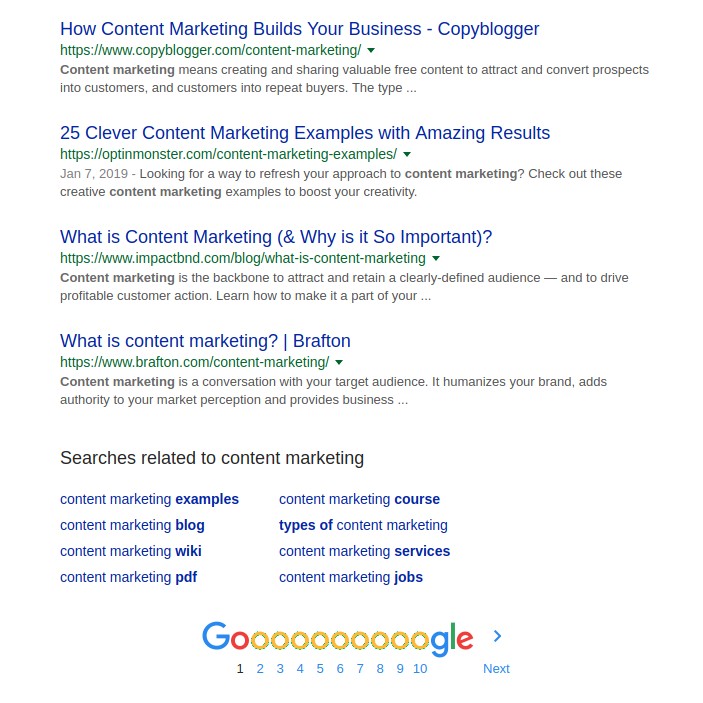
What you are seeing in the screenshot above are semantically related searches which Google routinely displays at the bottom of your first page of results. You can easily compare these with those “people who bought this item also bought” suggestions that are now so popular in online shops.

Creating content that covers more than a few of these related searches will improve your chances to rank on more than one popular search but we shouldn’t be looking at this in such a “robotic” manner.

Basically, Google’s goal is to boost content that answers the direct query, but also any important related questions to that subject matter. They want us to create content that provides the users with specific answers but also with as much of the “bigger picture” as possible.

It is quite possible to rank a single, in-depth piece of content for multiple queries and rank it better than creating numerous short-form content pieces to target them individually.

In-depth vs Long-form content

It is widely known that Google ranks longer content higher than short content. Still, content length and content depth are not the same – not by a long-shot.

There are a lot of articles out there that deal with the same subject matter, have the same (or nearly the same) word count but their rank is not even close.

Still, content length is a factor in creating in-depth content but it wouldn’t be right to assume that that’s all it takes to create in-depth content. Fluff is fluff, no matter how big your word count is and Google is getting better and better at identifying fluffy content.

Furthermore, according to OkDork and their 100 million articles analysis, articles that are below 1000 words are sixteen times more numerous than those that surpass the 2000 wordmark.

This only makes sense, as shorter content is less costly and takes less time to produce but it also tells us that, if we want to improve our contents’ chances to rank high, we need to make it longer.  

They’ve also concluded that longer-form articles get radically more shares. Longer content is seen by users to be indicative of better resource quality and due to that, it gains credibility.

Still, it is worth noting that there is a limit to how far content length can take your content. Niel Patel covered this subject thoroughly providing his own content as an example. He gives a year by year analysis of his experimentation with content length and the results he managed to rack up.

This was his conclusion about articles that surpass the 10,000-word mark: “They are still in-depth, but I found that after 10,000 or so words there are diminishing returns.”

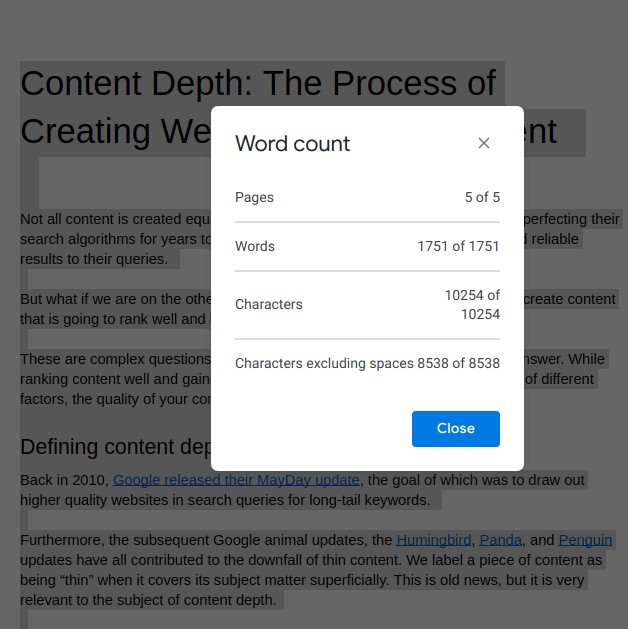
In my experience, content length should be decided based on the subject you are attempting to cover. But, if I had to define a content length sweet spot, I’d say that it stands somewhere between 1600 and 2500 words.

Advanced research

Most content these days is well-written, meaning that it is grammatically correct, its style and voice are on point, and the form is decent. However, when it comes to research and the density of information, most of these pieces will fall short. The reason for this has to do with the amount of research that goes into them.

Most experienced content writers will tell you that writing a piece is not a big deal – researching and understanding the subject matter is what makes up the majority of the writing process.

We’re going to outline some of the best practices that seasoned writers use to research a complex subject and find credible information to base their content on:

1. The primary source

When we are searching for information to base our article on, we run into many different sources along the way. The most common mistake made by authors around the world is taking all that information they find for granted.

In a lot of cases blogs, news portals, and other sources provide a piece of information by referring to a primary source. Inexperienced writers will just reference the secondary source without even taking a look at the original, which can jeopardize the credibility of the information used.

Humans are fallible and secondary sources may misquote a piece of information, take it out of context, or jeopardize its integrity in some other way. Furthermore, the primary source may not be as reliable as you have been led to believe by the secondary source.

Not all studies and statistics have been done by using the best practices proposed by the scientific method and you might want to check them out before you use them as a cornerstone for your content.

2. Rely on niche authority sources

One of the biggest challenges for writers working in a niche they haven’t covered before is identifying reliable and credible sources to draw information from. Both search engines and users view articles that cite seasoned authors, authority publications, and institutions as higher quality content.

How do you find reliable sources if you don’t have much knowledge about the niche you are currently covering? Well, this isn’t that hard actually. There are a lot of round-up articles out there which cover relevant publications, experts, and institutions for any particular niche. This is a good starting point.

3. Information freshness

When we are creating a piece of content, we want it to be based on the most recent findings and facts. How far back we go in our search for information depends on the subject we are covering, but we still want to ensure that the sources we use are still relevant at the time of the content being published.

Let’s say that we want to write a piece about “content writing” and we start doing our research. We can easily run into articles, whitepapers, studies from 5-10 years ago which were relevant at the time of their publishing.

However, content writing has evolved beyond recognition since then and we can’t rely on these old studies as relevant sources for covering this particular subject today.

Still, you should use common sense in these situations, as not every subject matter that we cover will be subject to as much change as our example, but the important thing is not to fall into the trap of going for a source that is outdated.

4. Wikipedia is a starting point

Every writer has relied on Wikipedia at one point or another. This online encyclopedia is very useful to familiarize with a subject you don’t know enough about. Wiki pages are useful in many ways. You can skim through to get a general idea about the topic, find various sources, dot down the basics, and so on.

Still, Wikipedia pages are created and moderated by volunteers. They are also not always up-to-date with the latest information about every possible topic.

I really hate it when people say that you shouldn’t use Wikipedia when doing research. You should, but it should be a starting point for your research, not the totality of it.

5. Learn to use Google

While Google is becoming more and more proficient at discerning our intentions and the meaning of our queries based on the context, it is still some time away from actually reading our minds.

This means that we need to know how to communicate our queries well and, while the Google search engine may seem simple to a casual user, writers need to be aware of and able to use Google’s advanced features.

We are not going to even attempt to list all the ways you can hone a search by using Google, and we are not even going to claim that all these features will be useful to you. Still, being able to narrow down your search and communicate what kind of information you are going to get increases the chances of getting better results to your queries.

Conclusion

Creating content that has depth is a complex process and one that takes time. Sure, specialized authors may be able to create a high-quality piece of content in a matter of hours, but they will be able to do so only when they are familiar with the subject, know all the relevant sources, and all they need to do is put a concept together and write it.

If you are after quality and want to create true value for the people who land on your article, you’ll have to show attention to detail and create a piece that is built on facts. Otherwise, you’ll end up with an SEO article most people will spend 5 to 10 seconds scanning before they hit that back button.