Categories
Blog

How to Research a Subject You Have No Familiarity With

How does Michel Houellebecq, the name of fine literature, know so much about haploid gametes? I can imagine him writing by the window, Paris rooftops laid like beautiful women as far as the eye can see. It’s 1997, the end of Western civilization. The rooftops are burning, and Houellebecq is drafting Atomised

But that’s completely off-topic.

Speaking of which, the question is pending – how come writers know so much about everything?

Now Houellebecq is smirking: research, research, research

In my humble experience as a content writer, I’ve become an expert in hair transplants, HR, bed bugs, data collection, proxies, crypto trading, interior design, credit cards, THC, and legal contracts. That was only this month. Over the years, I’ve written about everything, from soup to nuts – and I loved it. 

How do I research all these specific, often obscure, niche topics?

A writer must read – a lot.

puzzle pieces spelling out 'read more'

And I don’t mean books. Well, I read them, too, and I warmly recommend creating a habit out of it, but more on that later. Whether you’re a hired writer or a wanna-be auteur, you should do a lot of reading. You might have a different topic each day or not; the approach is still the same – before you write, read.

You can research most topics with Google at a glance and in-depth. 

For every 800-word article, I typically spend an hour googling and reading – at least.

When a topic doesn’t ring any bells, like the aforementioned haploid gametes, I keep reading until I know enough to explain the subject matter to my toddler (he’s pretty smart). Of course, the depth of knowledge you should acquire depends on the level of expertise you’ve been requested to deliver. 

In any case, researching a topic means reading about it. 

Finding the best sources

You should know that most articles on the internet are paid. They’ve been written by experts-by-the-hour, writers like you and me. Regrettably, not all of us approach our jobs with the same work ethic. Not all of us care about integrity. Some of us have better things to do. Somewhere else to be.

Be that as it may, you should learn to recognize a lazy writer from the first sentence.

Curated sources are not all bad, far from it, but reading the source material is better. As a rule of thumb, credible sources such as encyclopedias, textbooks, and scholarly journals are the best. Common problems with these sources are their length, inaccessibility, or technical jargon.

For quick research, the best alternatives are:

  • Online magazines that conduct their research;
  • News outlets that write and post first-hand reports;
  • Websites with .edu and .org domains (all reputable).

When researching less academic-oriented topics, such as blogging or beauty, you generally have to rely on your digital and information literacy. You will learn to recognize a (real) expert blog writer in time. You can also tell when that writer is trying to sell something without actually selling it.

That is something you get from experience, so reading is critical. 

Evaluating source credibility 

working desk

There is a systematic way of double-checking information quality, though.

Many writers use the so-called CRAAP test, which California State University developed in 2004 to help students with their research. You can apply it to both academic papers and blog posts. Considering how much misinformation circulates the internet lately, anyone could benefit from using the CRAAP test.

Here’s how it goes:

  • Currency: Is the source up-to-date?
  • Relevance: Is the source relevant to your research?
  • Authority: Where is the source published? Who is the author? Are they considered reputable and trustworthy in their field?
  • Accuracy: Is there evidence to support the source? Are the claims cited correctly?
  • Purpose: What was the motive behind publishing this source?

The last one – purpose – is the one I use most frequently. I’ve mentioned this earlier, but it’s too important not to do it twice. A whopping percentage of online content exists for content marketing purposes. Educational, glad-to-be-of-help content is so rare that you can spot it from miles away. 

Active reading as a practice

All the best writers I know take notes. 

Note-taking is so incredibly helpful because it forces you to pay attention and helps you process and acquire information on the go. You can do it the old-fashioned way, using a pen and paper. You can also download a browser extension that lets you highlight in different colors as you read.

Having two screens also helps, or you can split one screen in half. That will enable you to take notes directly in the document where you’ll be writing the article and keep researching the topic on the other half of the screen. I’ve found the highlighter thingy and split-screen combo to be the most effective. 

In addition to notes, there’s another component to active reading: curiosity.

So, let’s talk about that. 

Nurturing an open mind

Although I already knew a trick here and there, I spent some time reading about this topic before researching “researching” became too meta for my taste. Perhaps I’ve become a research expert since most of the best practices were already familiar to me. However, to my surprise, I did learn something new:

People love researching topics they know nothing about. 

Many of us take immense pleasure in finding answers to random questions like “How do bikes work,“ “Why is 70% of Spain empty,“ “Who is Michel Houellebecq,“ or “What’s the purpose of life.“ There’s joy in setting intellectual challenges and pushing the boundaries of knowledge. Researching and learning are at the center of that.

As writers, we should try not to forget that. 

Research every subject matter as thoroughly as you can for the sake of curiosity, which inspires change and breeds creation. Learn something new to potentially teach somebody something important. Study your haploid gametes. Don’t just wing it because your pasta has just arrived (super creamy, by the way). 

Next time you’re researching an unfamiliar topic, open your mind and keep reading. 

Categories
Blog

7 Most Common Issues Content Writers Face With Writing Projects

Stephen King once said, “If you want to be a writer, you must do two things above all others: read a lot and write a lot.” It’s a long and winding road with streams of creativity and occasional obstacles like the notorious writer’s block.

That condition of creative stall aside, content writing is a fantastic way to enrich your knowledge as it requires constant reading and learning. You encounter numerous topics and become an expert in multiple fields over time. After all, being a jack of all trades is in a content writer’s job description.

However, stepping into content writing shoes brings many challenges. Here are the most common you might experience and tips to overcome them.

1. Lack of target audience information

Writing a compelling copy that resonates with readers is impossible if you don’t know your target audience. You must understand their needs, pain points, desires, and opinions to connect with them, engage them with every word, and provide real value.

Whether a client showers you with information on a specific niche market or their target audience is broad, research it to understand its problems and language. That’s the only way to write with purpose, develop top-notch content, and achieve your client’s goal.

2. Poor communication with clients

two businessmen discussing a project in front of laptops

Communication can make or break your writing projects. Spoiler alert: sometimes, it’s not you; it’s them.

Not every client uses clarity when communicating their vision and goals. Some don’t go into details, leaving you with vague or confusing instructions. Others set no expectations upfront, providing only a keyword or a link to include in the piece.

You must ask for the specifics to ensure you’re on the same page and eliminate unnecessary back-and-forth conversations. The more information you have, the easier it will be to hit the bullseye and exceed your client’s expectations.

3. Unfamiliar topics

Your content writing journey will take you to paths you’ve never crossed before. Unfamiliar topics might scare you away, but that’s the exciting part that grips and compels you to push the boundaries of knowledge and discover new possibilities.

Yes, it’s all about research. I don’t mean googling a topic and reading only the first few sources – that’s not nearly enough to understand it inside out.

Lazy writers take that path of least resistance to save time, ignoring the unquestionable fact that in-depth research is crucial to delivering high-quality, informative, relevant, accurate content.

Take at least an hour to study the building blocks of an unfamiliar topic before putting words on paper, virtual or otherwise. That’s the key to creating well-researched content that impresses every client.

4. Limited creative freedom

Many content writers find restrictions on creativity frustrating. How to create a compelling piece if you have to lock your creative muse in a cage?

Unfortunately, this challenge has only one solution – adhering to your client’s instructions. Not respecting their wishes could cost you the project and hinder your future collaboration.

If the topic allows it, you could ask for some degree of artistic expression, ensuring you don’t stray off the path if the client gives the green light.

5. Insufficient SEO knowledge

an image of macbook on a wooden desk

You can’t develop relevant, authoritative pieces that rank high in SERPs (search engine results pages) without SEO (Search Engine Optimization) knowledge.

When I started my career in content writing, I had no idea what SEO  meant. Anchor text, meta description, backlinks, you name it – loads of terms I had never heard of before.

I knew I had to get down to business and learn everything. I acquired new skills that clients valued and expected and have been honing them ever since because search engine algorithms keep changing, making room for further improvement.

Take the time to master SEO, and you’ll consistently create brilliant content.

6. Ensuring readability

Many content writers struggle to communicate ideas, often getting lost in their thoughts and moving away from a project’s primary goal.

They write overly long sentences trying to convey the message, insert unnecessary adverbs and adjectives, and use too much technical jargon that makes the content difficult to understand. Complex diction and uncommon phrases also plague content pieces when a writer wishes to sound more proficient.

That negatively affects readability and the potential for the target audience to read the content and take action.

Write concisely, break your content into short paragraphs, and use numbered or bulleted lists to improve readability.

To enhance your writing’s authority, integrity, and quality, use a readability checker like Hemingway Editor or Grammarly.

7. Never-ending revisions

Revisions are sometimes necessary because, after all, every client should receive a high-quality piece that meets their needs. However, some clients might ask for seemingly endless rewrites that exhaust you mentally and physically.

This problem ties back to communication. Discuss expectations with every client before starting a project and ask for any references that might steer you in the right direction.

Most importantly, limit revisions because you don’t want to waste precious time if you can’t see eye to eye with a client. Drawing a line will prevent incessant micromanaging that stands in the way of your creativity.

Final thoughts

These challenges are only a glimpse of the obstacles you’ll encounter as a content writer, but don’t let them scare you away. You can overcome them quickly and enjoy a fulfilling, rewarding experience.

Don’t forget to improve your time-management and organization skills to keep procrastination and distractions impacting productivity at bay, especially when dealing with tight deadlines.

Categories
Blog

Aspects of SEO That a Content Writer Needs to Be Familiar With

If you’re a content writer, you’re probably aware of the ever-increasing need to improve your SEO content writing skills. SEO is virtually a science, but it’s also a modern-day art form.

As an SEO writer, your job is to keep your mind open, research new trends, and find the best way to please your biggest fans – your readers and search engines like Google. 

However, what works for readers may not work for Google and vice versa. So, the trick is to develop a unique style that can satisfy both your target audience and the most popular search engines in the world.

Just as you need to feel the pulse of your audience to produce the best content that’s a real treat for their needs, you should do the same for search engines. You need to learn some of the essential SEO content principles and practices to do that. 

This short guide will share some facts on the best SEO writing practices, the essential SEO terms you should know, and some valuable tips for writing top SEO content.

SEO writing and types of SEO content

types of content on laptop

Any content that aims to achieve as high a ranking as possible in the search engine results pages (SERPs) is defined as SEO content. Writing such content requires high-quality writing skills and analytics proficiency.

You need to make your content SEO-friendly if you wish to see it rank high in SERPs. However, optimization isn’t enough to achieve your goal of writing perfectly optimized content for search engines. 

The texts you write must achieve two primary goals:

  • Conveying your message and emotion to resonate with the reader’s sentiment;
  • Providing all the necessary facts to explain the target keywords and phrases.

To achieve these goals, you should synonymously optimize your content for both your audience and keywords.

Google is designed to address the needs of internet users. If your content can please the needs of your readers, they’ll spend more time reading it, which will improve your traffic and click-through rates. 

The result will be an astonishingly high ranking for your content and more than a satisfying bounce rate. For your information, bounce and click-through rates are two vital ranking factors.

Now that you have some basic information about SEO writing, let’s list some of the best content types for top SEO ranking:

  • Lists – top 10 most popular tools, web design ideas, Google searches in 2022, etc.;
  • Guides – guides are articles that provide in-depth explanations on a particular topic, including tips, definitions, strategies, etc.;
  • Articles – news, features, interviews, etc.;
  • Videos – ranging from long-form videos to bite-size clips, video content is the most popular and engaging on the internet; 
  • Blog posts – a blog is the best way to connect with your target audience, answer their questions, and improve your SEO ranking by targeting specific queries and keywords;
  • Infographics – the best visual presentations to provide in-depth explanations for internet users looking for quick answers and capture quality organic traffic;
  • Product pages – serving as landing pages for PPC campaigns, product pages provide product descriptions to help readers understand how specific items work and what they can do;
  • How-to guides – articles that provide step-by-step instructions on how to use a particular product, tool, program, application, etc.;
  • Slideshows and images – presentations, graphics, charts, etc.

Now, let’s move on with the essential SEO terms every modern-day content writer should put their finger on.

Essential SEO terms for your content-writing vocabulary

SEO terms on sticky notes around laptop

Here’s a comprehensive list of the critical SEO terms to keep in mind.

Long-tail keywords

Containing 3-6 words, these are sets of specific keywords, terms, or phrases.

SERPs

As mentioned earlier, SERPs are search results pages on a search engine. When an internet user performs a query, they will see the results that they can further explore.

It’s vital to mention the position of SERPs or the accurate ranking in Google Analytics. The best listings are those that appear on the first page of Google.

Anchor text

Anchor text can be a word or a phrase that contains a hyperlink that leads to the desired web page, blog post, etc. It’s an excellent way to direct your readers to another blog post to keep them longer on your website.

Meta description

Since internet users have a short attention span, you need an engaging and attention-grabbing summary of your page that can compel them to click on a result in their SERPs. Keep it short, concise, and between 155-160 characters.

Click-through and conversion rates

A click-through rate is a percentage of clicks for a particular result in SERPs that shows how many times users have searched for that result. A conversion rate tells you how many users have clicked on your website, blog, or a specific page to take the desired action.

Organic traffic

Organic traffic is the number of users who deliberately landed on your website via a search engine.

How to write SEO-friendly content

Content marketing

Here are the top tips on writing SEO-friendly content.

  1. Avoid keyword stuffing and add keywords naturally to keep your audience engaged.
  2. Provide content that answers the essential questions of your target audience.
  3. Create your SEO strategy by adding keywords throughout the content, including the introduction, last paragraph, and headings.
  4. Make sure your content is clear, error-free, and readable by using bullet points, short paragraphs, coherent sentences, and subheadings.
  5. Add keywords to meta descriptions to encourage readers to engage with your content.
  6. Add images and short descriptions to make your content more accessible and searchable.
  7. Add videos and other visuals to increase engagement and ranking.
  8. Add backlinks to direct your readers to high-quality content on authoritative websites. 
  9. Make sure your articles are reader-friendly, relevant, informative, accurate, and unique.
  10. Know the language of your readers and cater to it.
  11. Add internal links to help search engines understand your site structure and index and rank your website.
  12. Use long-tail keywords to create engaging headings.
  13. Make sure your content contains LSI-related keywords.

There, now you’re free to knock yourself out by writing the most SEO-friendly content of your life.

Conclusion

We sincerely hope this short guide helps you rank your content much higher than before. SEO is an ever-evolving science that will never stay the same. It constantly grows, changes, and transforms from one shape to another. Keep in mind that there’s no one-size-fits-all solution for writing top-grade SEO content. 

It all comes down to how much time, effort, and resources you’re ready to invest in discovering the endless SEO possibilities. Always put your readers first and revisit your content from time to time to make sure it follows the latest SEO practices.

Categories
Blog

The Elusive Goal of Creating Content That Is “Good Enough”

Writing excellent content is the key to content marketing, blogging, and SEO. It’s an essential part of your website, yet many companies often overlook it. Text is a universal medium you can use to communicate with clients properly and provide valuable information. 

People will always want content, but their opinions and needs change. It can sometimes be challenging to keep up with those evolving needs and deliver adequate materials. However, there are some general rules you can always follow. 

For example, readers don’t want to get bombarded with messages, brands, products, and irrelevant services. Content creators need to stay on top of the current “climate” and understand consumer behavior and interests. 

Research is paramount.

A vortex of books.

Research is crucial, especially for blog posts, no matter what kind of content you work on in your niche. Even when writing on a topic you’ve covered before, it’s essential to get updated with the latest trends, events, and statistics. 

However, it’s not only about researching once you’ve figured out your topic. As a blogger, you need to be interested in the issues you cover and stay ahead of the curve. That means reading and learning constantly. 

Proper research will help you deliver valuable information in your posts. You will also be able to brainstorm unique posts nobody has covered before. If you want people to read your blogs, you will have to offer something more than just recycled posts. 

  • Gather information from reliable sources. 
  • Focus on top Google results. 
  • Use tools to discover trending topics with relevant keywords. 
  • Always use the opportunity to learn something new. 

If you want to write well, you’ll have to read.

Girl reading a book.

As mentioned earlier, one of the bloggers’ essential qualities is staying updated with the relevant narrative. Most people focus on their writing and don’t read anything unless they’re doing research, but that is a lazy approach. 

Being interested in your niche and constantly acquiring more information to stay relevant is the key to success. The best blog posts are unique, and creating something new is often easier said than done. Sure, you could do something nobody has done before but is it precious for your target audience? 

To create both original and valuable content, you need to have a lot of knowledge at your disposal and connect the dots nobody else has. For example, if you want to compare three different products and give your readers the real “scoop,” you will have to learn about, test, and see what others think about them. 

  • Take the time to read whole posts. 
  • Look for opposing views. 
  • Reading helps you improve your writing skills as well. 

Share your input and opinions.

Blogs aren’t technical writing, and you have a lot of room to be creative. After all, this type of content is equally about entertaining people as much as educating them. So, there’s room to be subjective and share your experiences. 

When you are publishing in a particular blog niche for a long time, you get a better perspective and can offer something new. It’s generally a good idea to be bold. State your opinions to engage readers and make them want to criticize your work or agree with you. 

However, do that only when you have the knowledge and experience necessary to make conclusions. Otherwise, sharing unfounded claims will backfire and make you look like you don’t know what you’re talking about, driving readers away from your blog. 

  • Nurture your creative side. 
  • Don’t be afraid to share controversial opinions. 
  • Think outside the box. 
  • Share facts and statistics backing up your claims. 

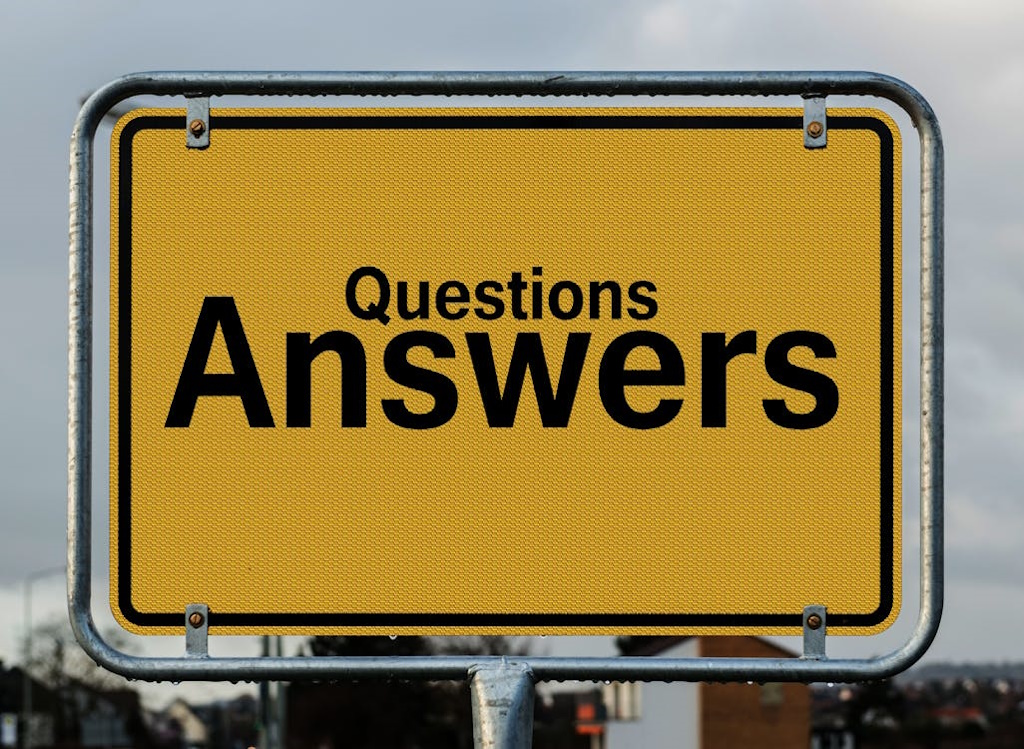
Think of your blogs as long answers to specific questions.

Questions and answer sign.

Relevance is vital, and every niche has its fair share of unanswered questions.

Most people are reading and searching for blogs that will concisely answer their questions. Before you start writing a post, check if someone else has already given answers to the same questions. 

If there are no answers available, make sure to give them. Even if there are specific answers but don’t provide all the relevant information or have a different approach, it’s also a good idea to write on that topic. 

With this kind of approach, you will be able to tackle more relevant issues and quickly come up with unique topics. Of course, it might require some time and effort to see if someone has covered that topic online, but it’s worth it. 

  • What questions are bothering you? 
  • See what questions are repeated online. 
  • Start with a simple question and branch out. 

Before you go 

Creating “perfect” content is a never-ending challenge, and you have to treat it that way. Readers, stories, and you change, meaning that a good blog post today might be irrelevant in a couple of years. As a writer, you have to be prepared to keep on learning and hone your skills.

Categories
Blog

Improving the Accessibility of Your Content for Better Results

When it comes to web content, hardly anyone talks about accessibility or knows anything about it. However, it’s essential to make the most of all options in this hyper-competitive business environment. That is where content accessibility comes into play. 

On top of that, working on this aspect of your website will help you create a stronger brand with great values. Providing a fantastic user experience with your content was a thing of improvisation in the past, but today we have the best practices and data available. 

You only have to be willing to use them to your advantage. Just because you’re producing content doesn’t mean that you’re too cool to follow specific guidelines that ultimately bring you results. 

What are the Web Content Accessibility Guidelines? 

Puzzle pieces spelling out the word 'what'.

The Web Content Accessibility Guidelines (WCAG) are an international standard set by W3C (World Wide Web Consortium). This standard defines making your web content accessible to people with special needs, neurological disabilities, learning issues, language problems, cognitive or speech impairments, visual disabilities, etc. 

With these guidelines, you can make your content more usable and accessible to older people and regular users.

The W3C released the first WCAG in 1999, and the current standards are WCAG 2.0 and WCAG 2.1. These two are pretty similar, but the 2.1 version includes additional requirements for mobile accessibility. 

Crucial principles of the WCAG 

These guidelines include four essential design principles that outline how content becomes accessible. Accessibility is a vast topic that can focus on coding approaches to legal regulations. However, you can apply the four WCAG principles to any aspect of accessibility. Here are short descriptions of each.

  1. Perceivable 

The first primary thing content should allow users is to process information quickly. Avoid using formats for your content that are difficult to process. That also means giving textual content for people who can’t hear and audio content for those with sight problems. 

It’s vital to add various assistive technologies to help users consume content differently. Just think about it: are there pieces of content color-blind people, people with low vision, or people with hearing loss can’t perceive on your site? 

  1. Operable 

Operability is another essential principle. After all, people need to be able to operate and use your content with different tools. For example, many people can’t use a mouse, so it’s a good idea to include keyboard operation. 

Usage should be more forgiving as people with disabilities are more likely to make mistakes. Include confirming options, cancellations, warnings, and instructions for completing actions.                                

  1. Understandable 

Just because your content can be usable and appropriately perceived, it doesn’t mean people can easily understand it. All of your content should have concise and clear language that is easy to understand. When someone acts, they should expect logical outcomes. 

Implement consistency across your content and include forms with clear labels and logical flow. Even though your content should be different, it should have a familiar structure. 

  1. Robust 

People use various technologies, and you should optimize your content to perform seamlessly across different browsers, devices, and platforms. However, that doesn’t mean that you should optimize for old web browsers or Windows smartphones. Offer flexibility but within the “regular” limits. 

How content accessibility helps 

A helping hand at sunset.

Content accessibility guidelines aren’t just about meeting standards. You can get real benefits that will help your business and your customers. Here are some advantages you should know. 

Better user experience 

At its core, content accessibility is about user experience focusing on easy content navigation, responsiveness, readability, and the ability to view and interact with it in various ways, depending on users’ needs. Content is all about user experience, especially since Google’s SEO guidelines emphasize that. 

More people will see your content.

People looking at laptop.

The more accessible your content is, the more people will click on it. All people with disabilities will respect that you’ve made things easier for them and made your content easy to access.

However, it’s not only about people with disabilities, as typical users will also check out what you have to offer. 

More people are likely to consume your content.

When producing content, you should know that persuading people to click on your content is equally challenging as making them stay and consume it.

Modern consumers have short attention spans and are used to having a perfect experience. If they don’t get it, they will leave, which you can’t allow. 

Conclusion 

To sum things up, there are four crucial areas of your content you should check when assessing the level of accessibility. Make your text large enough and structured adequately with short paragraphs, sentences, and lists. 

Create a consistent content hierarchy with a logical flow to make things easier to understand. It’s not just working on your content but also making it readily available to everyone.

Categories
Blog

A Complete Guide to Website Copywriting in 2022 (Part 1)

Becoming a copywriter is not as easy as it sounds. You will encounter many challenges, and some topics might utterly confuse you. Luckily, I’m here to walk you through some of the essentials for website copywriting. I’ve been where you are and picked up many tricks throughout my writing journey.

You may have the necessary motivation to become a copywriter, but your imagination is the most vital tool you will need. As long as you are creative enough, the act of writing will be the most enjoyable task. 

Before jumping into the matter itself, let’s see what website copywriting is. This notion might be perplexing, but I will explain everything you need to know about this job. 

What is website copywriting?

A laptop with an open notebook in front of it

Website copywriting means researching and writing content for a particular website. This type of writing differs from those you may be used to because the content must be engaging enough to compel readers to take specific actions, such as purchasing a product or hiring a service.

When it comes to website copywriting, you need to create and organize your content in a coherent and meaningful way to get as many readers as possible. 

Whether you write content for your brand or a client, you want to make it stand out from the competition’s websites. You need to be creative and write content the way you would like to read it. 

Sometimes, you will need to step out of your comfort zone and look at some things from different perspectives. That way, your content will be objective and satisfy the readers

Still, many more elements affect the quality of website copywriting, and I’ll get to that in a moment. 

Start from the top

It is essential to put your mind into creating an engaging headline for your text. Would you want to read something that seems simple, boring, and cliche at first glance? If the answer is no, you are probably aware of the powerful effect of catchy headlines.

When creating a headline, you want to think outside the box. Ask yourself whether the title you came up with is something that people will be interested in and something that will get their attention. 

A good headline is half the work – if you come up with a creative one, you will have the motivation to write inspiring, informative, and engaging content. Invest your time into this part because it will work wonders. 

Understand the subject matter of the website copywriting

Before you start writing a text on a specific topic, you need to ask yourself how much you know about it. If you can talk about it for more than five minutes, you will need little to no further research. 

On the other hand, if you get confused just by looking at the topic or the title, you will probably need to get more information about it. Various sources can help you learn something new about anything; you only need the motivation to learn. 

That is crucial for writing high-quality content because you cannot educate others when you know nothing about a particular matter. Be confident in what you know, and remember that research is paramount.

Write content with purpose

When writing website content, ask yourself these questions:

  • Is this text helpful?
  • Is it coherent?
  • Will the readers be able to focus on and understand the message?
  • Is the writing clear and concise?
  • Does the content serve the primary purpose?

Most copywriters go through an interview with themselves when writing content. There will always be a lot of questioning, but the more you question yourself, the better your text will turn out. 

There are probably many articles, guides, or studies about the topic you are working on, so explore them to get ideas and gather facts.

Be innovative to get more readers. Create something that doesn’t seem ordinary, something catchy that will attract your readers’ attention.

However, don’t overexplain everything. Keep your sentences short, concise, and precise. Your readers won’t get lost in your text and will get all the information they were looking for without getting bored. 

Another thing I would like to mention is that you need to keep track of your content during writing. You should always connect every part of the text coherently, tie ideas together, and ensure each sentence and paragraph flows naturally from one to the next.

Otherwise, you will get a messy, unrelated, and confusing bunch of words that make no sense to anyone. Details matter a lot in copywriting, so pay attention to them to tell a gripping story that entices people to keep reading and take action.

Focus on grammar

As a website copywriter, you must focus as much care on your grammar as on the actual content. People don’t want to read or learn from someone who doesn’t seem to understand the essential grammar rules.

Like with any other means of transferring information, copywriters must use impeccable grammar. It might seem like you are uneducated if your grammar isn’t correct. 

Many available tools on the internet, such as Grammarly, can help you write grammatically correct content. You can use these tools when you feel stuck – they will surely help you. It is not embarrassing to use them; most copywriters nowadays consider them their best friends.

Additionally, don’t make any spelling mistakes when you write your content. Readers would think you quickly ran through your text, wrote it lazily, and are not that interested in the topic. Remember, you are not texting; you are transferring knowledge to other people.

Correct grammar and spelling can do wonders for your texts, so pay attention to them. Reread your text multiple times to avoid grammatical and spelling mistakes and make an excellent impression. 

Do your research

I cannot stress the importance of research enough. Yes, we all know that researching something can get a bit too stressful, but trust me, it is all worth it. Extensive research is one of the most critical factors that affect the quality of your work. 

Sometimes, you will sit at your computer or with a particular book in your hands for hours until you find all the details you need to start creating your content. Other times, you will have all of the information you need right in front of you. 

Whichever the case, you will need to spend some time researching. You must be able to give your readers accurate information at all times. You cannot just go and make up information – it must come from a reliable source. 

Moreover, you need to ensure that all the information you mention is up-to-date. You wouldn’t want to put statistics from the previous century into your content because everything changes over time. 

Instead, use data that has been published over the previous several years. 

The researching part may be the most challenging leg of the copywriting journey. However, once you master it, you will start enjoying doing your research. 

Look at it as a good thing; while conducting your research, you will acquire information unconsciously, which will help you learn continually. You will probably become one of the wisest people in the room.

While you’re here, check out the second part of this guide to website copywriting to discover other essentials for enhancing your writing.

Categories
Blog

Content Depth: The Process of Creating Well-Researched Content

Not all content is created equal. Google and other search engines have been perfecting their search algorithms for years to provide users with the most comprehensive and reliable results to their queries.

But what if we are on the other side of the search engine? What if we want to create content that is going to rank well and bring traffic to our website?

These are complex questions and we’d like to present you with a part of the answer. While ranking content well and gaining organic traffic is a process that involves a lot of different factors, the quality of your content is the most essential one – this is why well-researched content is crucial.

Defining content depth

Back in 2010, Google released their MayDay update, the goal of which was to draw out higher quality websites in search queries for long-tail keywords.

Furthermore, the subsequent Google animal updates, the Humingbird, Panda, and Penguin updates have all contributed to the downfall of thin content. We label a piece of content as being “thin” when it covers its subject matter superficially. This is old news, but it is very relevant to the subject of content depth.

This means that ever since 2010, content depth has been a major ranking factor, but what makes a particular piece of content in-depth?

Well, most usually, content is built upon a set of keywords which are currently in-demand and are relevant for the business or organization putting out the content. These keywords can be extremely limiting and usually don’t cover the topical broadness that Google can assign to a well-researched piece of content.

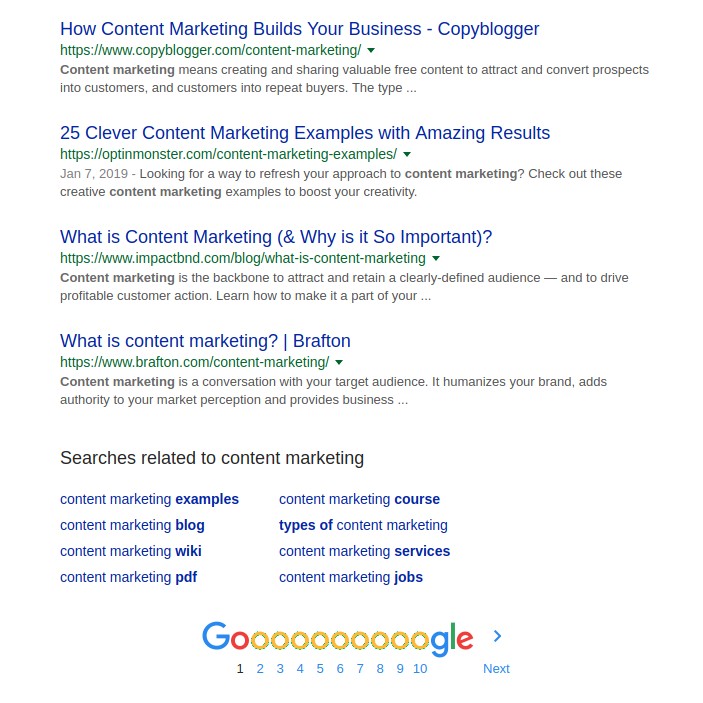
Meanwhile, Google has become very sophisticated at figuring out the contextual and semantical meaning behind user queries.

What you are seeing in the screenshot above are semantically related searches which Google routinely displays at the bottom of your first page of results. You can easily compare these with those “people who bought this item also bought” suggestions that are now so popular in online shops.

Creating content that covers more than a few of these related searches will improve your chances to rank on more than one popular search but we shouldn’t be looking at this in such a “robotic” manner.

Basically, Google’s goal is to boost content that answers the direct query, but also any important related questions to that subject matter. They want us to create content that provides the users with specific answers but also with as much of the “bigger picture” as possible.

It is quite possible to rank a single, in-depth piece of content for multiple queries and rank it better than creating numerous short-form content pieces to target them individually.

In-depth vs Long-form content

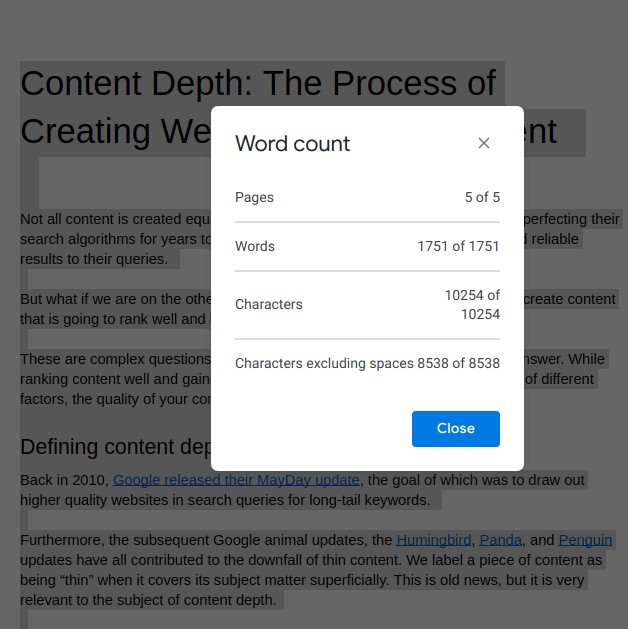
It is widely known that Google ranks longer content higher than short content. Still, content length and content depth are not the same – not by a long-shot.

There are a lot of articles out there that deal with the same subject matter, have the same (or nearly the same) word count but their rank is not even close.

Still, content length is a factor in creating in-depth content but it wouldn’t be right to assume that that’s all it takes to create in-depth content. Fluff is fluff, no matter how big your word count is and Google is getting better and better at identifying fluffy content.

Furthermore, according to OkDork and their 100 million articles analysis, articles that are below 1000 words are sixteen times more numerous than those that surpass the 2000 wordmark.

This only makes sense, as shorter content is less costly and takes less time to produce but it also tells us that, if we want to improve our contents’ chances to rank high, we need to make it longer.  

They’ve also concluded that longer-form articles get radically more shares. Longer content is seen by users to be indicative of better resource quality and due to that, it gains credibility.

Still, it is worth noting that there is a limit to how far content length can take your content. Niel Patel covered this subject thoroughly providing his own content as an example. He gives a year by year analysis of his experimentation with content length and the results he managed to rack up.

This was his conclusion about articles that surpass the 10,000-word mark: “They are still in-depth, but I found that after 10,000 or so words there are diminishing returns.”

In my experience, content length should be decided based on the subject you are attempting to cover. But, if I had to define a content length sweet spot, I’d say that it stands somewhere between 1600 and 2500 words.

Advanced research

Most content these days is well-written, meaning that it is grammatically correct, its style and voice are on point, and the form is decent. However, when it comes to research and the density of information, most of these pieces will fall short. The reason for this has to do with the amount of research that goes into them.

Most experienced content writers will tell you that writing a piece is not a big deal – researching and understanding the subject matter is what makes up the majority of the writing process.

We’re going to outline some of the best practices that seasoned writers use to research a complex subject and find credible information to base their content on:

1. The primary source

When we are searching for information to base our article on, we run into many different sources along the way. The most common mistake made by authors around the world is taking all that information they find for granted.

In a lot of cases blogs, news portals, and other sources provide a piece of information by referring to a primary source. Inexperienced writers will just reference the secondary source without even taking a look at the original, which can jeopardize the credibility of the information used.

Humans are fallible and secondary sources may misquote a piece of information, take it out of context, or jeopardize its integrity in some other way. Furthermore, the primary source may not be as reliable as you have been led to believe by the secondary source.

Not all studies and statistics have been done by using the best practices proposed by the scientific method and you might want to check them out before you use them as a cornerstone for your content.

2. Rely on niche authority sources

One of the biggest challenges for writers working in a niche they haven’t covered before is identifying reliable and credible sources to draw information from. Both search engines and users view articles that cite seasoned authors, authority publications, and institutions as higher quality content.

How do you find reliable sources if you don’t have much knowledge about the niche you are currently covering? Well, this isn’t that hard actually. There are a lot of round-up articles out there which cover relevant publications, experts, and institutions for any particular niche. This is a good starting point.

3. Information freshness

When we are creating a piece of content, we want it to be based on the most recent findings and facts. How far back we go in our search for information depends on the subject we are covering, but we still want to ensure that the sources we use are still relevant at the time of the content being published.

Let’s say that we want to write a piece about “content writing” and we start doing our research. We can easily run into articles, whitepapers, studies from 5-10 years ago which were relevant at the time of their publishing.

However, content writing has evolved beyond recognition since then and we can’t rely on these old studies as relevant sources for covering this particular subject today.

Still, you should use common sense in these situations, as not every subject matter that we cover will be subject to as much change as our example, but the important thing is not to fall into the trap of going for a source that is outdated.

4. Wikipedia is a starting point

Every writer has relied on Wikipedia at one point or another. This online encyclopedia is very useful to familiarize with a subject you don’t know enough about. Wiki pages are useful in many ways. You can skim through to get a general idea about the topic, find various sources, dot down the basics, and so on.

Still, Wikipedia pages are created and moderated by volunteers. They are also not always up-to-date with the latest information about every possible topic.

I really hate it when people say that you shouldn’t use Wikipedia when doing research. You should, but it should be a starting point for your research, not the totality of it.

5. Learn to use Google

While Google is becoming more and more proficient at discerning our intentions and the meaning of our queries based on the context, it is still some time away from actually reading our minds.

This means that we need to know how to communicate our queries well and, while the Google search engine may seem simple to a casual user, writers need to be aware of and able to use Google’s advanced features.

We are not going to even attempt to list all the ways you can hone a search by using Google, and we are not even going to claim that all these features will be useful to you. Still, being able to narrow down your search and communicate what kind of information you are going to get increases the chances of getting better results to your queries.

Conclusion

Creating content that has depth is a complex process and one that takes time. Sure, specialized authors may be able to create a high-quality piece of content in a matter of hours, but they will be able to do so only when they are familiar with the subject, know all the relevant sources, and all they need to do is put a concept together and write it.

If you are after quality and want to create true value for the people who land on your article, you’ll have to show attention to detail and create a piece that is built on facts. Otherwise, you’ll end up with an SEO article most people will spend 5 to 10 seconds scanning before they hit that back button.

Categories
Blog

Important 2018 Google Updates to Look at Before Creating New Content

SEO is a tricky niche to be in. While most marketing niches evolve at a steady pace, there are few of them out there that suffer as many changes over the course of a year. Furthermore, these changes in the way things function are rarely announced in a straightforward manner.

Google is in a tricky position. The company wants to help users rank well and optimize their websites to improve the experience for the people visiting them, but Google doesn’t want to reveal too much and risk their algorithm becoming susceptible to manipulation.

Due to this shroud of mystery, we are often forced to look for information about new updates to their algorithm outside their official channels. This is especially true when a particularly impactful update rolls out and causes our organic traffic to take a dip, so we start scrambling all over the web in search of an answer to why this happened.

At the beginning of the year, it’s a good idea to take a look at the updates to Google’s search engine algorithm that have been verified and explained – if you haven’t been keeping track on a daily basis. This can help you identify any updates you might have omitted and make the necessary changes to account for it.

We’re here to talk about the major updates that happened to Google’s algorithm but also a few that were added to the engine’s features, toolset, and so on.

1. New Search Console (January 8)

Google used the beginning of 2018 to put a smile on the faces of webmasters, SEO experts, and website owners with the release of their new Search Console.

The important thing was also that they provided 16 months of stored data in the Search Performance report. Some new features included the Index Coverage report and a change to AMP status and Job Posting report.

2. The Mobile Page Speed Update (January 18)

While the title of this update may seem threatening, Google officials claimed that it would impact a really small part of queries. Although it was announced in January, it rolled out in July and officials stayed true to their word. This update focuses on penalizing mobile websites that are extremely slow and don’t even offer a reasonably optimized experience.

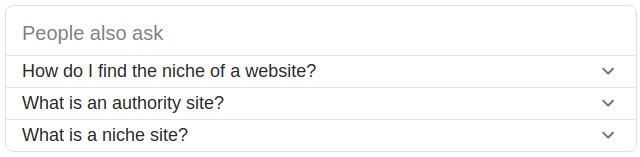
3. ”People Also Search For” (February 13)

This one went live as soon as it was announced and immediately impacted all desktop queries. While at first glance this may not seem like much, for those of you that optimized for more than one keyword and included long-tail keywords, there may be a chance to be included in more than one query.

Also, it improves the chances of somebody going for a longer keyword if they don’t find the thing they are looking for in the SERP for their initial query.

4. Crawler Limits (February 19)

This is isn’t an update that directly impacts SERPs or the algorithm, but is important for SEO experts and website admins. Namely, an arguably small amount of Search Console users have been abusing and spamming the re-crawl option.

This led Google to a decision to limit the number of re-crawls for both bulk and single links. We went from 500 single URL crawls within 30 days to up to 10 links per day. Also, the “select and crawl URL and all the pages it links” option, which was limited to 10 re-crawls in 30 days, has been switched to a more reasonable 2 crawls a day.

As you can see, the numbers are not that limiting and will not create issues for White Hat users who don’t use this feature that often. Black Hat users, on the other hand, might be facing some difficulties, as they need far more testing. Still, the limitations are quite reasonable and will not cause major issues for users.

5. Multifaceted Featured Snippets (March 1)

For a long while now, Google has been trying to improve the way their AI and algorithm understand the context and meaning behind user queries. Featured snippets are a part of this, as they provide two options for queries that can mean two different things based on context.

This means that a great number of websites may find themselves in the “0” position in the SERPs. This “0” position is reserved for ideal answers to a query and come with a larger snippet.

6. Relevancy (March 9)

This was rolled out as an unnamed update and impacted those websites whose content ranked more based on the quality of their website rather than the quality of the content they put out. The websites that got hit are mostly big brand websites which put out duplicate content.

The goal of the relevancy update is to provide the best answer to a user query based on the quality of content rather than the quality of the overall domain that holds it. Furthermore, it seems that Google’s idea to push for long-term quality content is really taking root.

This update pushes this idea even further into the forefront so keep this in mind the next time you are thinking about your content calendar.

7. Mobile First Indexing (March 26)

This is a global, multilingual update which means that it affects everyone indexed on Google. Still, the name of the update might be a bit misleading.

Basically what this update does is prioritize mobile versions of websites for indexing in some situations. These situations include separate URLs for mobile, dynamic serving, AMP, and non-AMP (canonical AMP not included).

8. Snippet Length Revert (May 13)

Back in December 2017, Google rolled out an update to their snippets, boosting their maximum character count from around 160 characters to 300+ characters. However, this experiment seems to have outlived its usefulness and was set back to around 160 for desktop and 130 for mobile SERPs.

Even though Google assured users that they didn’t need to expand their meta description and that the standard meta description length was absolutely fine, some people went and added characters to their old meta descriptions and, well, now is the time to do it all over again or is it?

According to a recent study conducted by Yoast, the majority of snippets are pulled directly from the web page, not from the designated meta description. Google’s advice is to not give too much thought to these.

9. Video Carousels (June 14)

Previously, videos were introduced in Google’s desktop SERPs through a feature called Video Thumbnails. On mobile, on the other hand, we’ve had the Video Carousels feature for some time.

Since June 14, Google introduced Video Carousels for the desktop, which almost completely replaced the Video Thumbnail feature (the instances where thumbnails still exist are too few and far between to matter).

As one of the more prominent differences between Video Thumbnails and Video Carousels, we would like to point out that YouTube videos have lost their almost exclusive right to these positions.

Video Carousels now feature a wide variety of video sources and provide users with more videos to choose from. While this may seem like a loss to some people, as they are being removed to position 4 or farther on the carousel, it also offers users a bigger choice pool and may disperse the organic traffic to more results.

10. HTTPS Becomes Mandatory (July 24)

Another update that was announced in February but rolled out in July. This is a very important one as Google, in its effort to promote improved user experience and security, made the HTTPS protocol mandatory.

They’ve also committed to this change by adding a warning for Chrome users that notifies them that a site they’ve landed on is not safe because it doesn’t have HTTPS.

Being that Chrome is used by somewhere around 50% of online users worldwide, this is a major deal for most website owners, as their websites might experience a tremendous increase in bounce rate due to this warning. HTTPS is neither that hard nor expensive to get – make the switch and be done with it.

11. Medic Update (August 1)

A large core update was released on August 1st and most prominently adjusted the health and wellness verticals. According to Search Engine Round Table, this update impacted the health niche significantly since out of all websites they included in their survey 41.5% were from this particular niche.

The runner up niche was the ecommerce niche with 16% but a lot of these websites sold medical and wellness products so the percentage of total websites from the medical niche is closer to around 50%.

From a user’s perspective, this makes sense. A lot more care should go into optimizing search results for all things related to medicine, as a lot of people tend to look for answers, medications, and other health-related information online.

If their search leads them to misinformation, fake products or other dubious results, the interaction can end in decisions directly hazardous to the users’ health.

Summing up

We would like to point out that these are not all the updates that Google rolled out in 2018. There is a significant number of smaller updates that have made their way to the live version of Google’s search engine but we’ve decided to focus on those that have a major impact on content and the way we optimize our websites.

It seems that Google’s focus for 2018 was to push their agenda of improving the quality of content that’s being ranked and doing so in a way that is focused on long-term quality. Furthermore, they are adjusting for the differences between mobile and desktop SERPs.

Another thing they focused on in 2018 was to penalize those websites that provided a substandard experience for users in the mobile environment. We are yet to see what 2019 will bring to the SEO table and what new conditions, as well as tools, Google will bring forth.

Categories
Blog

Back to Basics – What Do People Really Look for in Online Content?

It all started with forum posts, hideously designed 90s web pages with blocks of poorly formatted text, but as the Internet evolved, so did the content delivery platforms and the content itself. It wasn’t long before businesses jumped on the bandwagon, and around 88% of B2B marketers say that they use content marketing.

However, it’s not just serious business execs from large corporations that want to focus on creative content writing – everyone from hard working carpenters to soccer mom solopreneurs and photographers needs to put out content. It’s the only way to really grab people’s attention and build trust.

OK, so you’re saying that I can just churn out articles and get more visitors?

Now, since there’s such a big demand for online content, you’d think that it’s all about finding the cheapest way to produce tons of content, fill it with some keywords, share it on social media and BAM! – you’ve got yourself a content marketing strategy.

Well, I’m sorry to say that things are not that easy. In fact, tons of low quality content, keyword stuffing and posts on content farm blogs where the links leading back to your site stick out like a sore thumb will actually have a negative effect on your ranking in searches.

This is not to say that you can’t have some more promotional content here and there, but it has to offer something meaningful to the readers.

So, I need to improve my creative content writing skills, but what does that actually involve?

There’s a bunch of criteria we can look at to determine what makes an article great, memorable and engaging, but it all boils down to a few simple basics. You may later expand on these ground rules, but the following 7 things should be your guiding light when creating online content.

Useful or Interesting Information found in Online Content

One of the basic rules of creative writing is to “write what you know”, and writing about your own niche shouldn’t be much of a problem. However, you should never offer general information and sound bites that anyone with no clue about your industry can learn after 30 seconds of searching and 5 minutes of reading.

  • Useful information is all about:
  • In-depth analysis of key industry/niche concepts
  • Guides that show step-by-step solutions
  • Dispelling common misconceptions
  • Creative ideas on using different products and services
  • Actionable tips on improving one’s self or their business

In other words, the readers should feel that they’ve learned something that they can apply in their own lives after reading your content.

Entertainment Value

Not all content needs to be laugh-out-loud entertaining, e.g. case studies and articles covering serious scientific research should have a more serious tone, but in most cases, you can make an article easier to read by spicing it up with a unique writing style.

Finding the right tone and vocabulary will depend on many things including your:

  • Niche
  • Target demographic
  • Unique brand voice
  • Topic and social context

Generally speaking, you can make things a whole lot entertaining by using creative examples, personal experiences, funny comparisons, hyperbole, a bit of sarcasm, etc. Find the style that fits your brand identity and your audience’s preferences and stick with it.

Opinions and Elucidation

Although most of the basic topics in any niche will have already been covered by the time you decide to start writing about them, you can still offer a unique spin on a worn old topic. It’s not just about sparking controversy, but about voicing your own opinion and showing people that there’s more than one way to go about things.

Some well-know points are often covered only superficially, even though you’ll find them in dozens of articles. In such cases, you can make a whole article on a subtopic that others only mention in passing, and provide plenty of in-depth information to help people get a better understanding of how things work and why certain elements are very important.

For example, while everyone writing about growing a small business might mention that it’s important to find the right employees and the right connections, you can create a 2000 word article on how to network, earn social capital and build strong partnerships with other aspiring entrepreneurs.

High Readability

While there are still people who look for information in thick books with walls of text crammed into every page, most of us who do an online search want something that’s easy to digest. Formatting plays a major role in how your content is received and whether it will be shared.

Here are some general guidelines:

  • Keep your paragraphs short (two or three sentences)
  • Break the content down into plenty of subheadings
  • Add bullet points
  • Insert charts and infographics
  • Avoid the passive voice
  • Keep things concise

Needless to say, your grammar should be spotless.

Memorable Visuals

Creating great visual content is high on the list of marketing priorities of most businesses, and for a good reason – visuals grab people’s attention and they are more likely to remember content with images than just plain text.

An eye-catching feature image can get you more likes and shares on social media, but having the right images, charts, tables and infographics in the text is just as important. It will help you get the information across more effectively and help keep the readers interested.

Shareability

This is a bit of a vague concept that includes all of the previously mentioned points, but there is one more thing you need to cover to really motivate people to share your articles – the curiosity gap. Now, what you definitely shouldn’t do is go and spit out 10 clickbait titles and call it a day.

Your content has to deliver on the promise made in your title and you shouldn’t be too bombastic, but there are things you can do to get people interested in what you have to say. Here are a few ideas to get you thinking in the right direction:

  • Use power words to frame the title in a more interesting way
  • Draw the readers in with a snappy introduction
  • Spend some time on finding the perfect feature image
  • Offer prominent social sharing buttons on your blog

Getting all these little things right will often take a huge amount of time, which may seem disproportionate to what you’ll be getting out of it, but trust us, going the extra mile here will do wonders for you in the long run.

Variety

You can’t keep pumping out 2000 word articles on a daily basis and retain any semblance of quality, nor would your readers be able to keep up even if, by some miracle, you could offer dozens of great long articles every month.

This is why you need to vary things up a bit – follow up large information-dense articles with a couple of smaller tips-and-tricks posts, throw in a roundup or list article here and there, put out a short Q&A video or podcast once a month, etc.

Switch up the types of content you use, its length and the topics you cover, and you’ll keep things fresh and interesting.

To give people what they want, you need to know what they want in the first place. Seems fairly straightforward, right? The importance of creative content writing for your blog or link building campaign can’t be stressed enough, so go over the tips we’ve covered here one more time and you’ll be able to dramatically improve your content.