Content writing has come across many changes in the past few years. The act of creating content has a lot of dimensions when it comes to visual design. It can be very challenging to work on the visual presentation of your content, especially if you’re a rookie.
Therefore, you should learn as much as you can about design elements, fonts, and multimedia files and how you can use them to bring out the best in your content. However, it’s almost impossible to know the best way to design the visual presentation of your content.
Fortunately, I am here to help you on your journey! This article will help you understand the importance of visual elements and teach you how you can use them to enhance the quality of your content.
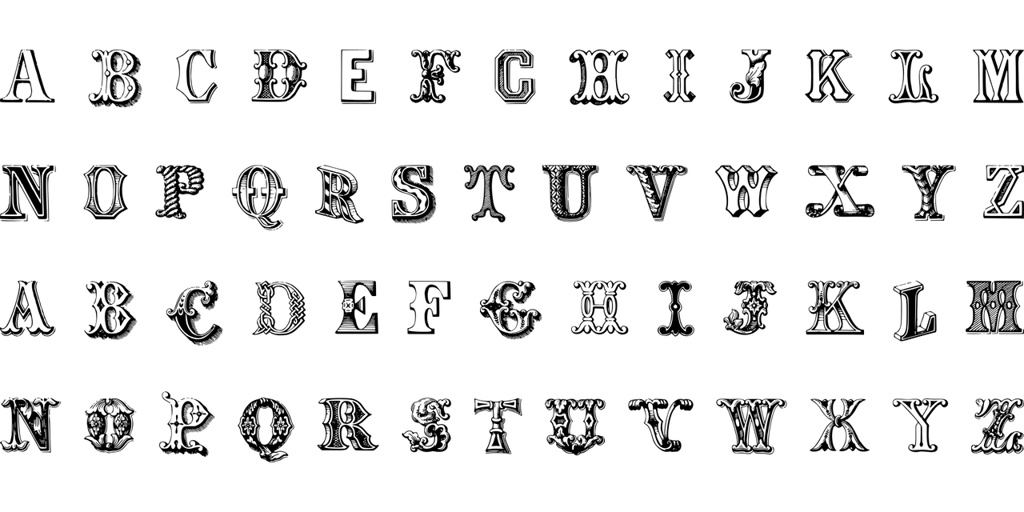
Fonts
The linguistic aspect of your content is one thing; the typographic element is another story.
As much as you pay attention to delivering the best possible textual content, you should also be aware of the importance of typography and the proper way to use it.
Make sure you use appropriate fonts for your content. For example, Comic Sans may not be the best choice for your business-related content. Also, avoid using fonts that are difficult to read, as they can draw attention from the actual content you’ve worked so hard on.
It’s best to follow your instinct and experiment with as many fonts as possible. We’re fortunate enough to have the opportunity of using thousands of fonts online. Explore them and choose the right font to make your content pop out in the best possible way.
Images
Images can boost your content on many different levels. Although you may think that they are often unnecessary, remember that people like to visualize everything and will most likely read your article if it has alluring visual elements.
I advise you to use images that will present your content in the best possible way. Although searching for the right pictures may be tiring, they can help you gain a higher reach within your target audience.
However, you shouldn’t just search for your desired photos on Google. Find royalty-free images you can legally use and keep an eye out for intellectual property rules to avoid paying hefty fees for copyright infringement.
Videos
Adding videos to your content can also bring out the best in your ideas. Videos can visually present your content and explain it to your audience way easier. They can boost your reach and visually satisfy your audience.
You can use videos in many different ways. You can create step-by-step guides that can explain your content more thoroughly. You can also use various videos to enhance your headings and boost your visual presentation.
However, make sure you don’t overdo it. Don’t forget that not every textual content needs a video, and sometimes a well-written text can be enough to inform your audience about a specific topic you’ve tackled.
Visual marketing
Marketing is one of the best traits in many industry branches nowadays. If you manage your marketing the right way, you won’t have any trouble finding the best visual presentation and call for action in the future.
Visual marketing consists of creating images, videos, and other multimedia elements for your content. Try to make a visual identity for the content you share in a way where your audience can recognize it as 100% original and high-quality.
You should know many visual marketing tricks before creating and managing your visuals. Try to blend your colors the right way, use the right fonts, and assemble all elements in the best possible way.
Design tools
You can use many available design tools to bring out the best visual presentation of your content. Design tools can help you achieve the best visualization for your content in the easiest way possible.
You can use different design tools related to graphic design, templates, collages, quote graphics, animation, font design, presentations, renders, charts, screenshots, slides, gifs, photos, videos, and even memes!
Different design tools offer various helpful features to enhance your visual presentation and let you avoid additional creative work. Remember, sometimes it’s better to work smarter than to work harder!
Infographics
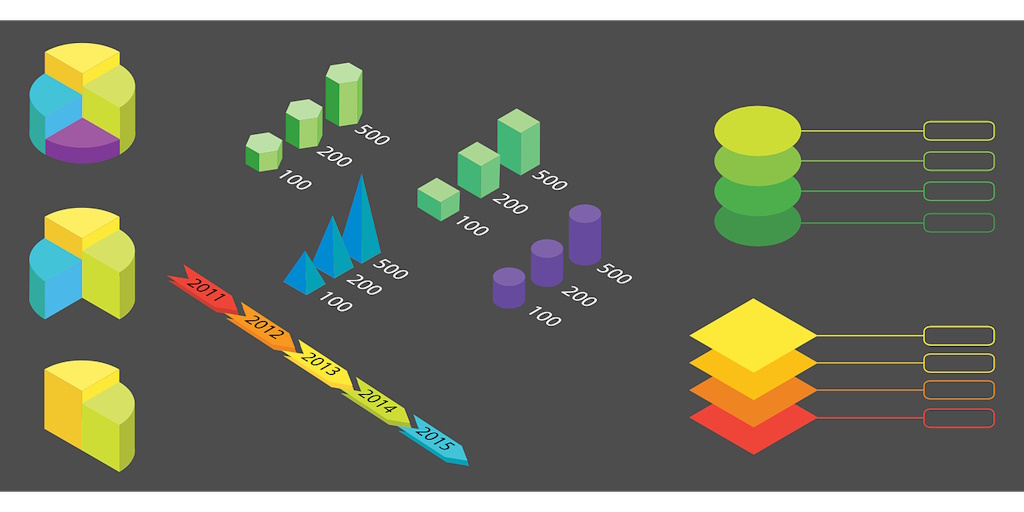
Infographics are there to visually present your data and make it easier to understand your content. You can use them to summarize your text and make content reading a more fun experience for your audience.
The most necessary thing in infographics is the overall design. Try to approach it in a fun way without losing your essential points. I advise you to use infographics when sharing various types of statistics and numerical data.
Try to understand that people will more likely access your content if you offer a visual presentation of your text. Let’s face it – not everyone likes to read a thousand-word article about any topic and would better understand it in a more visual and fun way.
Overall design
After you write your content, it’s time to choose the right font, images, videos, infographics, and other visual elements. You have to piece them together like a puzzle and create a meaningful visual experience for your readers.
The overall design of your page will make your audience stay and interact with your content. So, try your best to create a brilliant style and make it uniquely represent you.
If you ever hit a wall when designing the visual presentation of your content, don’t forget to search for inspiration online, as you can find many creative ideas and templates that can ease your design journey.
Conclusion
Content creation can often be stressful. Not everyone can do it, as it requires an eye for detail and a sense of style. Nevertheless, managing the visual presentation of your content can turn out to be pretty fun!
So, make sure you browse through infinite possibilities before choosing the correct elements for your design layout. There are many options to choose from, so try to stay patient and unleash your creativity.
When a company or business needs a writer to create marketing content, they typically look for either a content writer or a copywriter. However, people often confuse these two, and many think they are the same. Is there any difference at all between these two professions?
Of course, there is. Well, it’s not exactly the difference between pears and lemons, more like lemons and lime, but close enough. This subtle difference is significant, especially for young writers looking for new jobs and wanting to specialize in particular domains to pursue a writing career.
These two professions represent different challenges and skills that one must have to call themselves a content writer or a copywriter.
This post will help you understand the contrast between these two types of skills and closely explain their role in building a successful brand.
Here are some subtle but significant differences between content writers and copywriters.
Goals
Before writers create a fresh piece of content, they need to consider its purpose. That’s the first and probably the most notable difference between these two types of writing. Content writing and copywriting have different goals.
Copywriting promotes a persuasive voice and draws people to buy something, while content writing includes entertaining, educative, and subtler content. For example, most businesses online use text ads to compel their visitors to buy or try their products.
That’s why organic websites typically opt for content writing. Their goal is to have non-promotional content that will educate, inform, and entertain readers in noncommercial methods.
To catch people’s attention, content writers today must track the readers’ interests and provide them with entertaining content that they will want to read.
Copy forms
Initially, copywriting had a pretty limited level of content coverage. However, the internet changed the course for this writing type.
On the other hand, content writing is a more profound branch where people have an opportunity to gain expertise in different types of content. So, here is the list of copy forms that copywriters and content writers cover.
Copywriters and content writers don’t have the same writing skills. Yes, it’s a thin line, but there is still a difference in the skills these two types of writers must have and the challenges they face.
Copywriters are experts in writing content for different industries.
Copywriters serve a wide range of clients across industries, and they need to investigate and learn about them thoroughly. They must be willing to cover different sectors and have knowledge of various relevant topics.
Although their scope of work does not differ much from that of a content writer, a copywriter must specialize in creating content for specific fields, such as technology, or healthcare.
Content writers sell brands discreetly.
Unlike copywriters, content writers don’t use a promotional or seller voice in their content.
Instead, they are experts in creating perfectly balanced content that’s educational and interesting but still contains keywords and includes other essential SEO optimizations that will boost website ranking.
Copywriters must adapt to teamwork.
Copywriters typically work for industries with large marketing teams. If you want to specialize in copywriting but don’t know how to work in a team and communicate project specifics with project managers, your chances of success in copywriting are close to zero.
Content writing requires research skills.
To be a good content writer, you need to have advanced research skills. Content writing is all about facts and claims, and you need to master your research skills to back up all the points in your content.
In other words, to create valuable content, you must do profound research on the topic you’re trying to represent to readers.
Content length
Because content writing primarily focuses on informing and educating the readers, the length of content that copywriters and content writers use is entirely incomparable.
Copywriters typically need space only to compel and convince people to visit the website or buy a specific product, and they usually pack it all in a few sentences.
On the other hand, content writing requires in-depth motivation followed by informative and educational content. Depending on the topic, content writers typically need to write about 500 to 3,000 words to offer valuable content to the readers.
They typically use a non-promotional voice and need space to introduce the reader to the topic, provide helpful information, discreetly incorporate call-to-action phrases, and summarize why a brand or company deserves their trust.
Bottom line
Even though there are a few differences between these two types of skills, both are vital parts of digital marketing. However, if you want to try content writing or copywriting, you need to know your job description and understand your obligations and goals.
Becoming a copywriter is not as easy as it sounds. You will encounter many challenges, and some topics might utterly confuse you. Luckily, I’m here to walk you through some of the essentials for website copywriting. I’ve been where you are and picked up many tricks throughout my writing journey.
You may have the necessary motivation to become a copywriter, but your imagination is the most vital tool you will need. As long as you are creative enough, the act of writing will be the most enjoyable task.
Before jumping into the matter itself, let’s see what website copywriting is. This notion might be perplexing, but I will explain everything you need to know about this job.
What is website copywriting?
Website copywriting means researching and writing content for a particular website. This type of writing differs from those you may be used to because the content must be engaging enough to compel readers to take specific actions, such as purchasing a product or hiring a service.
When it comes to website copywriting, you need to create and organize your content in a coherent and meaningful way to get as many readers as possible.
Whether you write content for your brand or a client, you want to make it stand out from the competition’s websites. You need to be creative and write content the way you would like to read it.
Sometimes, you will need to step out of your comfort zone and look at some things from different perspectives. That way, your content will be objective and satisfy the readers.
Still, many more elements affect the quality of website copywriting, and I’ll get to that in a moment.
Start from the top
It is essential to put your mind into creating an engaging headline for your text. Would you want to read something that seems simple, boring, and cliche at first glance? If the answer is no, you are probably aware of the powerful effect of catchy headlines.
When creating a headline, you want to think outside the box. Ask yourself whether the title you came up with is something that people will be interested in and something that will get their attention.
A good headline is half the work – if you come up with a creative one, you will have the motivation to write inspiring, informative, and engaging content. Invest your time into this part because it will work wonders.
Understand the subject matter of the website copywriting
Before you start writing a text on a specific topic, you need to ask yourself how much you know about it. If you can talk about it for more than five minutes, you will need little to no further research.
On the other hand, if you get confused just by looking at the topic or the title, you will probably need to get more information about it. Various sources can help you learn something new about anything; you only need the motivation to learn.
That is crucial for writing high-quality content because you cannot educate others when you know nothing about a particular matter. Be confident in what you know, and remember that research is paramount.
Write content with purpose
When writing website content, ask yourself these questions:
Is this text helpful?
Is it coherent?
Will the readers be able to focus on and understand the message?
Is the writing clear and concise?
Does the content serve the primary purpose?
Most copywriters go through an interview with themselves when writing content. There will always be a lot of questioning, but the more you question yourself, the better your text will turn out.
There are probably many articles, guides, or studies about the topic you are working on, so explore them to get ideas and gather facts.
Be innovative to get more readers. Create something that doesn’t seem ordinary, something catchy that will attract your readers’ attention.
However, don’t overexplain everything. Keep your sentences short, concise, and precise. Your readers won’t get lost in your text and will get all the information they were looking for without getting bored.
Another thing I would like to mention is that you need to keep track of your content during writing. You should always connect every part of the text coherently, tie ideas together, and ensure each sentence and paragraph flows naturally from one to the next.
Otherwise, you will get a messy, unrelated, and confusing bunch of words that make no sense to anyone. Details matter a lot in copywriting, so pay attention to them to tell a gripping story that entices people to keep reading and take action.
Focus on grammar
As a website copywriter, you must focus as much care on your grammar as on the actual content. People don’t want to read or learn from someone who doesn’t seem to understand the essential grammar rules.
Like with any other means of transferring information, copywriters must use impeccable grammar. It might seem like you are uneducated if your grammar isn’t correct.
Many available tools on the internet, such as Grammarly, can help you write grammatically correct content. You can use these tools when you feel stuck – they will surely help you. It is not embarrassing to use them; most copywriters nowadays consider them their best friends.
Additionally, don’t make any spelling mistakes when you write your content. Readers would think you quickly ran through your text, wrote it lazily, and are not that interested in the topic. Remember, you are not texting; you are transferring knowledge to other people.
Correct grammar and spelling can do wonders for your texts, so pay attention to them. Reread your text multiple times to avoid grammatical and spelling mistakes and make an excellent impression.
Do your research
I cannot stress the importance of research enough. Yes, we all know that researching something can get a bit too stressful, but trust me, it is all worth it. Extensive research is one of the most critical factors that affect the quality of your work.
Sometimes, you will sit at your computer or with a particular book in your hands for hours until you find all the details you need to start creating your content. Other times, you will have all of the information you need right in front of you.
Whichever the case, you will need to spend some time researching. You must be able to give your readers accurate information at all times. You cannot just go and make up information – it must come from a reliable source.
Moreover, you need to ensure that all the information you mention is up-to-date. You wouldn’t want to put statistics from the previous century into your content because everything changes over time.
Instead, use data that has been published over the previous several years.
The researching part may be the most challenging leg of the copywriting journey. However, once you master it, you will start enjoying doing your research.
Look at it as a good thing; while conducting your research, you will acquire information unconsciously, which will help you learn continually. You will probably become one of the wisest people in the room.
While you’re here, check out the second part of this guide to website copywriting to discover other essentials for enhancing your writing.
Making a name for yourself as a content writer is a long-term effort. It requires staying committed and disciplined while always looking for new ways to improve your skills, workflow, and deliverables — tools for content writing are the first thing to take a look at as there are many that can help.
As time goes by, you will figure out that it’s impossible to provide the best content to your clients or audience without using the right tools. After all, you can’t make bricks without straw.
Fortunately, you don’t have to organize articles, find new article ideas, and improve writing manually or in a makeshift manner; there are tools for that.
Here are the top industry-standard tools for content writing professionals in 2022. We’ve conveniently placed them in categories according to their purpose.
Improve the quality of your writing with tools for content writing
As a content writer, it’s essential to acknowledge that writing is a skill that you can continuously improve. Fortunately, there are several tools to help you stay on your toes and improve the quality of your content over time.
Grammarly – improve your style, grammar, and spelling
Grammarly is one of the most popular online writing tools with Chrome and MS Office plugins. It also has dedicated apps for Windows, Mac, Android, and iOS. It automatically checks your copy for spelling and grammar errors as you type. That’s what it can do if you use a free version.
Should you decide to invest in Grammarly Premium, you can benefit from many other features, such as:
Plagiarism checker;
Essay checker;
Tone detector;
Style guide;
Snippets;
Analytics;
Brand tones.
Cliche Finder – improve the quality of your posts
Repetitive and overused phrases can significantly reduce the quality of your content. Remember, your content should provide value. Every word you write should contribute to value.
Cliche Finder is a perfect tool to have in your toolbox. It’s entirely free and will help you find the repetitive and overused phrases in your content.
Readable – achieve the desired readability level using tools for content to automate things
Most of the time, content writers are required to produce content for broad audiences. That means that your content should be easy to consume. If you use complicated words, long phrases, and paragraph-long sentences, you can quickly lose your readers.
That’s why you should ensure an optimal readability level. Readable is just the right tool for the job. It provides scores for all relevant readability indicators, including:
Flesch Kincaid Reading Ease;
Flesch Kincaid Grade Level;
Gunning Fog Score;
Coleman Liau Index;
Automated Readability Index (ARI);
SMOG Index.
All you have to do is copy and paste your content into Readable, and it will analyze it for you. It will pinpoint the sections that reduce the readability so that you can easily edit them.
Excel at SEO writing
It’s 2022; it would be redundant to speak about the importance of SEO. Here are several tools for content writing to help you excel at SEO writing and stun your clients.
Surfer SEO – optimize your content for higher ranking
The ranking potential of your content depends on how effectively you utilize your targeted keywords. Surfer SEO is one of the best premium tools for the job. It can help you discover additional search terms related to your primary keyword.
The platform also features automatic scoring to help you optimize your content for higher ranking while ensuring you don’t over-use any keywords.
Frase – streamline writing content briefs
Frase is another premium tool for SEO writing. While it can help you do your keyword research and write SEO-friendly content, it can also enable you to write more efficiently.
With Frase, you can streamline writing content briefs. The platform can generate optimized briefs on your topics in seconds.
MarketMuse – identify essential topics you need to cover
To ensure your optimized content provides the most value, you need to cover all essential topics. That is where MarketMuse comes in. It even has a free plan for you to test it.
Once you provide the keyword for your project, MarketMuse will provide all the vital topics you need to address in your content.
Optimize your workflow with content writing tools
While content writers work in a creative industry, it doesn’t mean that they can’t benefit from a bit of structure and automation. Here are some unique tools to help you optimize your workflow.
Almanac – create documents and collaborate in real-time
Almanac is a document editor platform that streamlines real-time collaboration. You will get access to a workspace designed with productivity and efficiency in mind. Plus, you get to customize it to your liking.
Almanac also helps you organize your documents and add custom metadata to your folders and files to help you find things with ease.
Google Docs – a powerful piece of software for content creators
Google Docs is a free platform that features excellent word processing capabilities. You can use it to streamline document creation, organization, sharing, and collaboration.
The platform comes with a built-in spelling and grammar checker, and the version control system and comments are beneficial for teams and working with clients.
Evernote – keep track of your projects
If you want to structure your writing process and still be able to track your projects, you should take Evernote for a test drive. You can write notes while doing your research and quickly convert them into to-do lists.
Evernote supports integration with Google Calendar to help you track and never miss a to-do. The only downside of using Evernote is that it doesn’t have an offline mode when using it for free.
Easily ensure a 100% unique copy with tools for content writers
Search engines have quite rigorous rules regarding plagiarized content. Let’s see how you can ensure a 100% unique copy.
Copyscape – the ultimate plagiarism checker
While there are many plagiarism checkers out there, Copyscape is considered the best of the best tools you can use to check your articles for plagiarism. It provides a premium service, but it’s surprisingly inexpensive.
Just copy and paste your article, and it will highlight the plagiarized sections with the links to the original content that you need to paraphrase or delete.
Duplichecker – a free plagiarism checker
Duplichecker is a free alternative to Copyscape. It works fast and comes with an intuitive interface. However, you can use it to check up to 1,000 words-long articles for plagiarism for free.
Get ideas for your articles
After writing hundreds of articles, you can quickly run out of fresh ideas for your content. Here are some tools to help you with that.
HubSpot Blog Ideas Generator – discover fresh blog ideas for free
HubSpot Blog Ideas Generator is a perfect tool to have on stand-by. You can use it whenever your creative juices stop flowing. All you have to do is type in your keyword, and the tool will provide five fresh blog ideas you can use for inspiration.
Portent’s Content Idea Generator – increase productivity with ready-to-use blog topics
Portent’s Content Idea Generator provides the same service as HubSpot’s tool above but with a comedy spin. You will get your ready-to-use blog topics whenever you experience writer’s block. However, jokes and witty remarks will accompany those topics to cheer you up and spark your creativity.
Tools for content writing are a guarantee of quality
You can use these industry-standard tools to become a better content writer. As a content creator, you have your unique needs and wants, so we will leave it to you to test the tools you find most beneficial to build your tech stack and stun your readership and clients.
Working with freelance writers can be challenging, as you may engage in a writing project with someone who doesn’t really have the right skills you need to get the job done right. You may end up paying for a piece of content of sub-par quality, riddled with poor grammar and confusing sentences.
However, the other side of the coin can be absolutely fantastic. When you work with highly-skilled and experienced freelance writers who know what they’re doing, you get perfect content that can help you take your business to the next level.
But even with the best of writers, you may not get what you want if you don’t communicate it clearly. Communication can make or break your writing projects, and it’s the key to forming meaningful, long-term relationships with freelancers.
So, before hiring any freelancer for a writing project, make sure you follow these crucial communication tips.
Determine What You Want Upfront
A to-do list for a writing project
Planning what you want down to the last detail before hiring a content writer will save you a lot of time down the road.
If you don’t have a clear vision for your project, you can’t expect your writer to understand it either.
Let’s say you’re starting a blog and need someone to fill it with high-quality posts regularly. But what exactly do you want to accomplish with your blog?
Are you looking to boost your SEO ranking and drive more traffic to your site, or do you want to increase your sales and generate more revenue? Do you want to establish yourself as a thought leader in your industry?
Whatever it is, sit down and create a solid plan. Having a clear vision upfront, whether it concerns your blog, landing page, About Us page, or any other content, will help you determine your writing project scope.
You’ll know precisely what kind of content you need to realize that vision and reach your goals. And when you know your goals, your writer will too.
Ask All the Right Questions
Before engaging a freelance writer in your project, you need to make sure you’re on the same page.
Asking the right questions will help you avoid that scenario where you hire the wrong person for a particular job.
Let’s face it; no one can know everything about every subject matter there is. And no one claims to know it all. But you need to know if your writing project may be outside a freelancer’s area of expertise. That’s where your questions come in.
Do you have experience in writing the type of content I need?
Can you adapt your writing style to the tone I need?
Are you available for long-term weekly or monthly projects?
Most importantly, ask about the pricing.
Most freelancers are completely honest and transparent about the pricing before they start a project, but make sure you ask point-blank. You certainly don’t want any surprises and overhead costs that you didn’t plan for.
Establish the Writing Project Expectations from the Get-Go
Once you establish a connection with a freelancer, communicate all your expectations for the project. Let them know what you need, also when you need it done, and what goals you wish to achieve.
Explain everything thoroughly so that they can determine whether or not they’re the right person for the job.
Perhaps your deadline is too tight, and they simply can’t deliver the project on time. If you don’t communicate the deadline clearly right away, you may end up with a rushed piece of content that doesn’t do either of you any good.
No one has the power to read your mind. So, don’t expect your writer to magically know everything you want them to include in the content if you’re not extremely clear from the onset.
If you don’t get into the specifics, you may be in for lots of revisions later. And no one wants that.
Misunderstandings happen all the time, but poor communication is always the only culprit. Luckily, you can eliminate any confusion if you’re always precise and specific straight away.
The more you get into details, the more your writer will actually appreciate it, because that means fewer revisions down the line. It ensures minimal back-and-forth and considerably lessens their workload, getting you exactly what you envisioned.
Make sure you get as much as possible in writing. That way, your freelancer can refer to all your instructions and notes anytime to make sure they don’t stray off the path.
If you don’t have any specific requests, at least let the writer know the value of the content in regards to your business. That way, they’ll have a much better sense of how to get around to writing it.
And that’s precisely why you need to have a clear plan upfront.
Don’t Leave Your Freelancer Hanging
One of the essential rules of communicating with a freelancer is to be available. No one expects you to be available 24/7, but you should be highly responsive.
There will be times when a writer successfully completes your project without contacting you again to go over the details. But if they encounter an issue along the way, they need to be able to reach you.
What if, while doing research, they had an excellent idea for making your content better, and they would like to ask for your approval to implement it?
What if they simply found your instructions a bit vague or confusing and need to check back with you to clarify everything?
If you don’t provide a timely response, the content quality may be sacrificed, especially if there’s a tight deadline.
Always Provide Meaningful Feedback
As Bill Gates once said, “We all need people who will give us feedback. That’s how we improve.” And he couldn’t have been more right.
Feedback is everything. Without honest feedback, your freelancer can’t know whether they hit the bullseye or not.
That’s especially important if you plan on hiring them for a long-term project. Giving constructive and honest feedback will enable them to provide you with impeccable content always.
So, don’t just send them a “Thank you” or “Great job!” in your follow-up. Tell them exactly why you liked the piece so that they can continue doing the same in the future.
Similarly, if you don’t happen to be particularly satisfied with the end result, don’t be afraid to say it. Explain what could be better, and they’ll make the necessary adjustments next time.
Every good freelance writer will appreciate it, and actually expect that level of honesty. It will save both of you tons of time in the future, as it will mean little to no revisions.
Working with a freelancer doesn’t have to be daunting. It can be an exciting experience that brings plenty of benefits to your business in the long run.
But the key to making it successful and completely stress-free lies in open, honest, and meaningful communication.
Are you looking for a highly-skilled and experienced freelance writer to provide you with top-notch content? We can hook you up! Contact us today to tell us about your writing project, and we’ll get back to you with a quote shortly!
Content writing is all about knowing what the readers want and giving them the information they need in a unique and fun-to-read package. The problem is, even when you’ve decided on the niche and know which topics you’ll need to cover, it’s easy to go too broad or too specific and lose your audience half-way through an article.
You need to offer different types of content for people of different skill levels and knowledge about your niche. How familiar someone is with the topic at hand will determine the depth of your content, the type of information you need to offer, the format and length, the language and style, and a whole lot more.
We will now break up the general audience into four broad categories depending on their level of expertise and knowledge, and then look at what kind of content will offer maximum engagement for each group.
Defining the Four Basic Experience Levels
While it’s true that experience is a sliding scale with no clear cut-off point, we can define four broad categories of readers based on this factor:
Newbie – someone who’s just stumbled upon the broader topic, or someone who’s been reading general articles on it for up to a few weeks.
Intermediate – someone who’s spent 2-3 months to a year intensely researching a topic and perhaps dabbling in it a bit.
Advanced Player – a person who’s done their research and been at it for a couple of years.
Expert – the die-hard enthusiast who has either been researching the topic and was involved in the activity for years, or someone who’s worked in the field for a while and has a professional interest in the topic.
A person from each of these categories will be looking for different things and will be able to handle different levels of complexity and technical jargon. Here are the broad strokes of what people need at various stages of competency in a topic.
The Newbie wants:
An overview of the broad topic and subtopics
Definitions of the important concepts and terms
Clarification about the core processes
Quick and dirty tips
Suggestions and recommendations
General guides and quick “How To” articles
The Intermediate wants:
A more detailed look at the most important subtopics
Clarification about the more advanced processes
Further research material suggestions
A list of experts to follow
Detailed guides
Comparisons of methods or products
The Advanced Player wants:
Answers to highly specific questions
Advanced tips and tricks
Further reading on microniche topics
Real-life examples from successful experts
The Expert wants:
Troubleshooting advice
Individualized tips and planning
Reviews and comparisons of products and services
A reliable company with a high-quality service
Answers that incorporate knowledge of other related niches
A Practical Example of the Different Type of Needs Within the Same Niche
A Newbie would be your average person with 20 extra pounds and a New Year’s resolution to start working out. They have a general idea of what they want – lose fat, develop firm and defined muscles, run up a flight of stairs without gasping for air.
They go through a few articles on sites with “healthy”, “live”, “fit” or “green” in their URL, and look for basic advice on exercise selection and dieting, perhaps a good beginner program.
Their Intermediate buddy who’s been working out for a few months and gotten some results will be looking for healthy food recipes, intermediate programming tips, some “tips and tricks” for a specific exercise, and so on.
The Advanced Player who’s been working out for two-three years now, on and off, needs more detailed nutrition advice, workout programs based on what works best for them and any limitations they might have, gym gear advice, supplement reviews, and so on.
The Expert has been in the fitness lifestyle for years, maybe even a decade or two, and has specialized in a certain area. They might look for nutrition advice for a crossfitter looking to add some strength before a competition, or maybe a good powerlifting program to get in peak strength for a powerlifting meet in three months.
The Expert may also be looking for the best gear for the money, hot to train around issues like biceps tendonitis or rotator cuff injury, and so on. They might even be considering opening their own gym, in which case the content would shift from pure fitness into the small business niche.
Should You Focus On One Experience Level or Cast a Wider Net?
In most cases, a brand’s audience will consist of several if not all of these experience levels. Even a company offering a highly specialized service to experienced professionals will have to face newbie-style questions.
These can come from those who are new to a specific software platform or have scaled their business and are unaccustomed to operating with so many employees.
New techniques, technologies or strategies take getting used to, so you’ll always have plenty of intermediates swimming around with the experts. In fact, there can be a sub-division within the “expert” category itself.
Someone who’s been bartending for five years and someone who has been running their own bartending school for a couple of years are on quite different levels. Even though they might have the same level of “mixing skill”, their needs, experiences, and questions will be dramatically different.
This is why it’s best to offer some content for each experience level.
5 Practical Tips to Organize Your Content Better
If you want to properly categorize your content and address the needs of each segment of your main audience, you need to be meticulous and patient. Here are a few simple points you need to address before you can start putting out a variety of excellent content:
1. Define the needs of each category – ask your audience for feedback, scour the online forums and blogs, look at the common questions on Quora, just find what people in each category are looking for.
2. Brainstorm at least 5 topic ideas for each category – sit down, see what the competition is doing, look at the most popular blog posts for each major topic, and try to offer something similar, but with a unique twist and more practical.
3. Create a content calendar for the next 2 months – don’t rush blindly into it and post whatever feels easy to write that week. Make sure mix things up and offer something for a different category each week.
4. Get other experts to weigh in on your blog – as long as someone has real value to offer through their content you can let them post on your blog and link to their site in the author bio. You can even spark conversations on social media.
5. Look at the metrics and adjust accordingly – reader feedback is a good starting point for brainstorming topic ideas, but numbers don’t lie and the metrics will tell you what kind of content works best for you and gets your audience excited. Focus on that type of content in the future, and go over tips 3 and 4 again.
Creating compelling content is an art and a science, particularly since you have to consider search engine algorithms on top of what your audience wants. However, it pays to consider all the different audience categories based on experience and skill.
It will allow you to engage the right people with the right content, allow you to mix things up and keep the topics fresh, and give you a chance to experiment and do some networking. It’s all about good research and meticulous planning, so get on it and stay patient.
Not all content is created equal. Google and other search engines have been perfecting their search algorithms for years to provide users with the most comprehensive and reliable results to their queries.
But what if we are on the other side of the search engine? What if we want to create content that is going to rank well and bring traffic to our website?
These are complex questions and we’d like to present you with a part of the answer. While ranking content well and gaining organic traffic is a process that involves a lot of different factors, the quality of your content is the most essential one – this is why well-researched content is crucial.
Defining content depth
Back in 2010, Google released their MayDay update, the goal of which was to draw out higher quality websites in search queries for long-tail keywords.
Furthermore, the subsequent Google animal updates, the Humingbird, Panda, and Penguin updates have all contributed to the downfall of thin content. We label a piece of content as being “thin” when it covers its subject matter superficially. This is old news, but it is very relevant to the subject of content depth.
This means that ever since 2010, content depth has been a major ranking factor, but what makes a particular piece of content in-depth?
Well, most usually, content is built upon a set of keywords which are currently in-demand and are relevant for the business or organization putting out the content. These keywords can be extremely limiting and usually don’t cover the topical broadness that Google can assign to a well-researched piece of content.
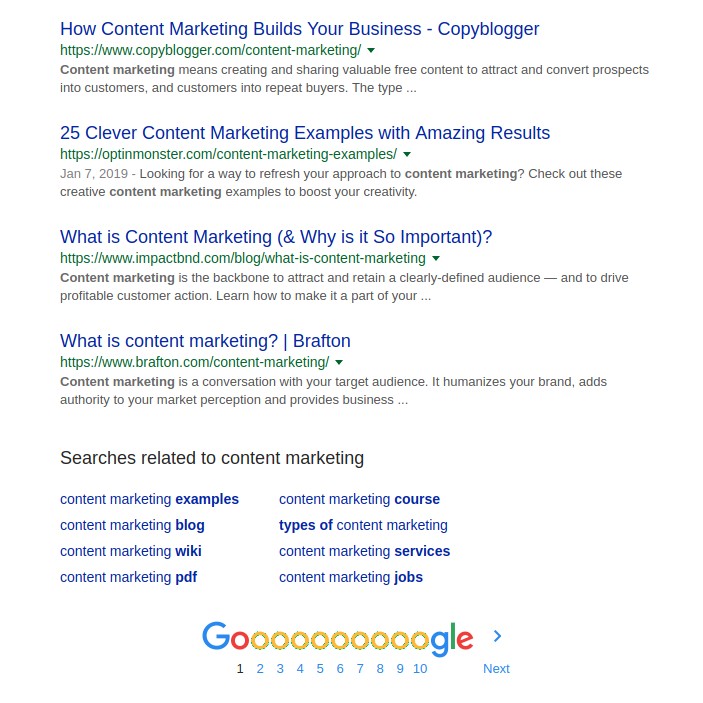
Meanwhile, Google has become very sophisticated at figuring out the contextual and semantical meaning behind user queries.
What you are seeing in the screenshot above are semantically related searches which Google routinely displays at the bottom of your first page of results. You can easily compare these with those “people who bought this item also bought” suggestions that are now so popular in online shops.
Creating content that covers more than a few of these related searches will improve your chances to rank on more than one popular search but we shouldn’t be looking at this in such a “robotic” manner.
Basically, Google’s goal is to boost content that answers the direct query, but also any important related questions to that subject matter. They want us to create content that provides the users with specific answers but also with as much of the “bigger picture” as possible.
It is quite possible to rank a single, in-depth piece of content for multiple queries and rank it better than creating numerous short-form content pieces to target them individually.
In-depth vs Long-form content
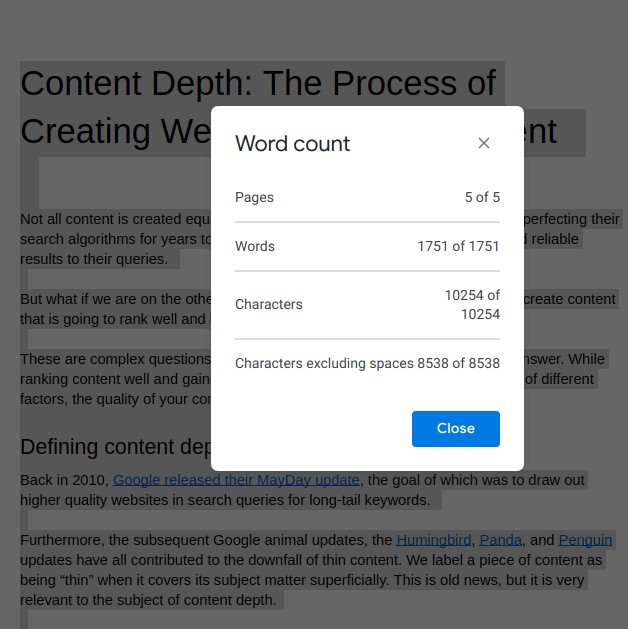
It is widely known that Google ranks longer content higher than short content. Still, content length and content depth are not the same – not by a long-shot.
There are a lot of articles out there that deal with the same subject matter, have the same (or nearly the same) word count but their rank is not even close.
Still, content length is a factor in creating in-depth content but it wouldn’t be right to assume that that’s all it takes to create in-depth content. Fluff is fluff, no matter how big your word count is and Google is getting better and better at identifying fluffy content.
Furthermore, according to OkDork and their 100 million articles analysis, articles that are below 1000 words are sixteen times more numerous than those that surpass the 2000 wordmark.
This only makes sense, as shorter content is less costly and takes less time to produce but it also tells us that, if we want to improve our contents’ chances to rank high, we need to make it longer.
They’ve also concluded that longer-form articles get radically more shares. Longer content is seen by users to be indicative of better resource quality and due to that, it gains credibility.
Still, it is worth noting that there is a limit to how far content length can take your content. Niel Patel covered this subject thoroughly providing his own content as an example. He gives a year by year analysis of his experimentation with content length and the results he managed to rack up.
This was his conclusion about articles that surpass the 10,000-word mark: “They are still in-depth, but I found that after 10,000 or so words there are diminishing returns.”
In my experience, content length should be decided based on the subject you are attempting to cover. But, if I had to define a content length sweet spot, I’d say that it stands somewhere between 1600 and 2500 words.
Advanced research
Most content these days is well-written, meaning that it is grammatically correct, its style and voice are on point, and the form is decent. However, when it comes to research and the density of information, most of these pieces will fall short. The reason for this has to do with the amount of research that goes into them.
Most experienced content writers will tell you that writing a piece is not a big deal – researching and understanding the subject matter is what makes up the majority of the writing process.
We’re going to outline some of the best practices that seasoned writers use to research a complex subject and find credible information to base their content on:
1. The primary source
When we are searching for information to base our article on, we run into many different sources along the way. The most common mistake made by authors around the world is taking all that information they find for granted.
In a lot of cases blogs, news portals, and other sources provide a piece of information by referring to a primary source. Inexperienced writers will just reference the secondary source without even taking a look at the original, which can jeopardize the credibility of the information used.
Humans are fallible and secondary sources may misquote a piece of information, take it out of context, or jeopardize its integrity in some other way. Furthermore, the primary source may not be as reliable as you have been led to believe by the secondary source.
Not all studies and statistics have been done by using the best practices proposed by the scientific method and you might want to check them out before you use them as a cornerstone for your content.
2. Rely on niche authority sources
One of the biggest challenges for writers working in a niche they haven’t covered before is identifying reliable and credible sources to draw information from. Both search engines and users view articles that cite seasoned authors, authority publications, and institutions as higher quality content.
How do you find reliable sources if you don’t have much knowledge about the niche you are currently covering? Well, this isn’t that hard actually. There are a lot of round-up articles out there which cover relevant publications, experts, and institutions for any particular niche. This is a good starting point.
3. Information freshness
When we are creating a piece of content, we want it to be based on the most recent findings and facts. How far back we go in our search for information depends on the subject we are covering, but we still want to ensure that the sources we use are still relevant at the time of the content being published.
Let’s say that we want to write a piece about “content writing” and we start doing our research. We can easily run into articles, whitepapers, studies from 5-10 years ago which were relevant at the time of their publishing.
However, content writing has evolved beyond recognition since then and we can’t rely on these old studies as relevant sources for covering this particular subject today.
Still, you should use common sense in these situations, as not every subject matter that we cover will be subject to as much change as our example, but the important thing is not to fall into the trap of going for a source that is outdated.
4. Wikipedia is a starting point
Every writer has relied on Wikipedia at one point or another. This online encyclopedia is very useful to familiarize with a subject you don’t know enough about. Wiki pages are useful in many ways. You can skim through to get a general idea about the topic, find various sources, dot down the basics, and so on.
Still, Wikipedia pages are created and moderated by volunteers. They are also not always up-to-date with the latest information about every possible topic.
I really hate it when people say that you shouldn’t use Wikipedia when doing research. You should, but it should be a starting point for your research, not the totality of it.
5. Learn to use Google
While Google is becoming more and more proficient at discerning our intentions and the meaning of our queries based on the context, it is still some time away from actually reading our minds.
This means that we need to know how to communicate our queries well and, while the Google search engine may seem simple to a casual user, writers need to be aware of and able to use Google’s advanced features.
We are not going to even attempt to list all the ways you can hone a search by using Google, and we are not even going to claim that all these features will be useful to you. Still, being able to narrow down your search and communicate what kind of information you are going to get increases the chances of getting better results to your queries.
Conclusion
Creating content that has depth is a complex process and one that takes time. Sure, specialized authors may be able to create a high-quality piece of content in a matter of hours, but they will be able to do so only when they are familiar with the subject, know all the relevant sources, and all they need to do is put a concept together and write it.
If you are after quality and want to create true value for the people who land on your article, you’ll have to show attention to detail and create a piece that is built on facts. Otherwise, you’ll end up with an SEO article most people will spend 5 to 10 seconds scanning before they hit that back button.
SEO is a tricky niche to be in. While most marketing niches evolve at a steady pace, there are few of them out there that suffer as many changes over the course of a year. Furthermore, these changes in the way things function are rarely announced in a straightforward manner.
Google is in a tricky position. The company wants to help users rank well and optimize their websites to improve the experience for the people visiting them, but Google doesn’t want to reveal too much and risk their algorithm becoming susceptible to manipulation.
Due to this shroud of mystery, we are often forced to look for information about new updates to their algorithm outside their official channels. This is especially true when a particularly impactful update rolls out and causes our organic traffic to take a dip, so we start scrambling all over the web in search of an answer to why this happened.
At the beginning of the year, it’s a good idea to take a look at the updates to Google’s search engine algorithm that have been verified and explained – if you haven’t been keeping track on a daily basis. This can help you identify any updates you might have omitted and make the necessary changes to account for it.
We’re here to talk about the major updates that happened to Google’s algorithm but also a few that were added to the engine’s features, toolset, and so on.
The important thing was also that they provided 16 months of stored data in the Search Performance report. Some new features included the Index Coverage report and a change to AMP status and Job Posting report.
2. The Mobile Page Speed Update (January 18)
While the title of this update may seem threatening, Google officials claimed that it would impact a really small part of queries. Although it was announced in January, it rolled out in July and officials stayed true to their word. This update focuses on penalizing mobile websites that are extremely slow and don’t even offer a reasonably optimized experience.
3. ”People Also Search For” (February 13)
This one went live as soon as it was announced and immediately impacted all desktop queries. While at first glance this may not seem like much, for those of you that optimized for more than one keyword and included long-tail keywords, there may be a chance to be included in more than one query.
Also, it improves the chances of somebody going for a longer keyword if they don’t find the thing they are looking for in the SERP for their initial query.
4. Crawler Limits (February 19)
This is isn’t an update that directly impacts SERPs or the algorithm, but is important for SEO experts and website admins. Namely, an arguably small amount of Search Console users have been abusing and spamming the re-crawl option.
This led Google to a decision to limit the number of re-crawls for both bulk and single links. We went from 500 single URL crawls within 30 days to up to 10 links per day. Also, the “select and crawl URL and all the pages it links” option, which was limited to 10 re-crawls in 30 days, has been switched to a more reasonable 2 crawls a day.
As you can see, the numbers are not that limiting and will not create issues for White Hat users who don’t use this feature that often. Black Hat users, on the other hand, might be facing some difficulties, as they need far more testing. Still, the limitations are quite reasonable and will not cause major issues for users.
5. Multifaceted Featured Snippets (March 1)
For a long while now, Google has been trying to improve the way their AI and algorithm understand the context and meaning behind user queries. Featured snippets are a part of this, as they provide two options for queries that can mean two different things based on context.
This means that a great number of websites may find themselves in the “0” position in the SERPs. This “0” position is reserved for ideal answers to a query and come with a larger snippet.
6. Relevancy (March 9)
This was rolled out as an unnamed update and impacted those websites whose content ranked more based on the quality of their website rather than the quality of the content they put out. The websites that got hit are mostly big brand websites which put out duplicate content.
The goal of the relevancy update is to provide the best answer to a user query based on the quality of content rather than the quality of the overall domain that holds it. Furthermore, it seems that Google’s idea to push for long-term quality content is really taking root.
This update pushes this idea even further into the forefront so keep this in mind the next time you are thinking about your content calendar.
7. Mobile First Indexing (March 26)
This is a global, multilingual update which means that it affects everyone indexed on Google. Still, the name of the update might be a bit misleading.
Back in December 2017, Google rolled out an update to their snippets, boosting their maximum character count from around 160 characters to 300+ characters. However, this experiment seems to have outlived its usefulness and was set back to around 160 for desktop and 130 for mobile SERPs.
Even though Google assured users that they didn’t need to expand their meta description and that the standard meta description length was absolutely fine, some people went and added characters to their old meta descriptions and, well, now is the time to do it all over again or is it?
According to a recent study conducted by Yoast, the majority of snippets are pulled directly from the web page, not from the designated meta description. Google’s advice is to not give too much thought to these.
9. Video Carousels (June 14)
Previously, videos were introduced in Google’s desktop SERPs through a feature called Video Thumbnails. On mobile, on the other hand, we’ve had the Video Carousels feature for some time.
Since June 14, Google introduced Video Carousels for the desktop, which almost completely replaced the Video Thumbnail feature (the instances where thumbnails still exist are too few and far between to matter).
As one of the more prominent differences between Video Thumbnails and Video Carousels, we would like to point out that YouTube videos have lost their almost exclusive right to these positions.
Video Carousels now feature a wide variety of video sources and provide users with more videos to choose from. While this may seem like a loss to some people, as they are being removed to position 4 or farther on the carousel, it also offers users a bigger choice pool and may disperse the organic traffic to more results.
10. HTTPS Becomes Mandatory (July 24)
Another update that was announced in February but rolled out in July. This is a very important one as Google, in its effort to promote improved user experience and security, made the HTTPS protocol mandatory.
They’ve also committed to this change by adding a warning for Chrome users that notifies them that a site they’ve landed on is not safe because it doesn’t have HTTPS.
Being that Chrome is used by somewhere around 50% of online users worldwide, this is a major deal for most website owners, as their websites might experience a tremendous increase in bounce rate due to this warning. HTTPS is neither that hard nor expensive to get – make the switch and be done with it.
11. Medic Update (August 1)
A large core update was released on August 1st and most prominently adjusted the health and wellness verticals. According to Search Engine Round Table, this update impacted the health niche significantly since out of all websites they included in their survey 41.5% were from this particular niche.
The runner up niche was the ecommerce niche with 16% but a lot of these websites sold medical and wellness products so the percentage of total websites from the medical niche is closer to around 50%.
From a user’s perspective, this makes sense. A lot more care should go into optimizing search results for all things related to medicine, as a lot of people tend to look for answers, medications, and other health-related information online.
If their search leads them to misinformation, fake products or other dubious results, the interaction can end in decisions directly hazardous to the users’ health.
Summing up
We would like to point out that these are not all the updates that Google rolled out in 2018. There is a significant number of smaller updates that have made their way to the live version of Google’s search engine but we’ve decided to focus on those that have a major impact on content and the way we optimize our websites.
It seems that Google’s focus for 2018 was to push their agenda of improving the quality of content that’s being ranked and doing so in a way that is focused on long-term quality. Furthermore, they are adjusting for the differences between mobile and desktop SERPs.
Another thing they focused on in 2018 was to penalize those websites that provided a substandard experience for users in the mobile environment. We are yet to see what 2019 will bring to the SEO table and what new conditions, as well as tools, Google will bring forth.
In Part One of our SEO checklist, we focused on on-site aspects of SEO, like preparing it for crawling. We dealt with various aspects of website optimization that would be considered good practices by search engines, and therefore, improve the website’s ranking. If you haven’t read the first one yet, you can find it here.
In this part of our SEO checklist, we are going to focus on the aspects of optimization that need to be done off-site, hence the name Off-Site SEO. Basically, the goal of this aspect of SEO is to improve the image of the website in the eyes of search engines, therefore improving its status and, through that, its rankings.
According to Search Engine Rankings Factors conducted by SEMRush, off-site SEO factors account for around 50% of all ranking factors search engines take into account. Furthermore, off-site factors are far more dynamic and proactive when impacting your rankings – it’s something you can consistently work on to improve and do so in continuity.
The parameters to focus on:
popularity
relevance
trust
authority
Now, we could focus on each of these parameters individually but that would be impractical since each and every off-page SEO technique will always impact more than one of these – if done properly, of course.
We’re going to split these off-site factors into two parts, links and social signals, but it should be obvious that these two aspects of off-page SEO are inseparable. How, you ask? Well, we’re going to give an example so that we can make the situation 100% clear.
When you create a quality link coming from, let’s say, an authority blog from your niche, you are actually getting more than just relevant link juice. Part of the traffic that lands on that page has a chance to, through the backlink you got, land on your website.
Furthermore, the article you published will most probably be shared by the blog in question on their social media pages. Some natural shares may occur as well. This means that you didn’t create just a static link but a PR “signal” that will have some kind of reverberation in the online environment.
The example above perfectly explains why SEO isn’t a precise discipline. A lot of things depend on other people. In some situations, the “viral potential” of your content may get you amazing results with practically no extra effort, while in others, the result ends up being minuscule despite your efforts.
Before we dive into how to actually work on your off-site SEO, we need to stress the importance of preparing your website for this kind of effort. Investing time and money into off-site aspects of SEO while your domain is a mess is basically like putting lipstick on a pig. The pig is still going to stink.
Now let’s dive into the link building aspect of SEO.
Links
When we talk about off-page SEO, we have to mention backlinks. They are still very powerful and impactful, but a lot of marketing “experts” used them in a spammy fashion, and Google doesn’t like spam. So, what is the white hat approach to this?
Well, there are a couple of things you can do we will start with the most common one.
a) Guest blogging – First thing’s first! If you wish to ensure that you don’t get punished for getting links, you should absolutely avoid paying for them. Guest blogging can be approached from a few angles.
You can approach websites that accept guest posts and get a link to your website from the bio or even from the content if you have a way to link to it naturally. The most common way to get a link from the article itself is to create relevant, well-researched, and well-written content on your domain so you can link it as further reading.
This takes some forethought and planning. To create this type of content for your blog, you need to have at least a general idea of where the content will be linked and the subject matter you are going to be dealing with in your guest posting campaign.
b) Link roundups – Being that content creation is a constant in the online environment, not all content will be 100% original in terms of subject matter. A lot of publications diversify their content by adding weekly or monthly roundups of the best content from their respective niche. If you want to be included in these kinds of roundups here is what you need to do.
First, you need to find the people doing these roundups. You can do this in a few ways. Prospecting potential roundups can be done by using Twitter and Google search without having to invest in a specialized tool. Just focus on the keywords that you are interested in and search for people who do roundups on a regular basis. Build up a list and see what kind of roundups they do. After that, you should focus on creating content that will be a good fit for the roundups you want to be a part of.
Being in a roundup can be very beneficial for a number of reasons. First, you get a link from a relevant source. Second, they share the roundup on their social media profiles. Third, the people who are also in the roundup will share the piece because they were mentioned. So, get ready for traffic.
c) Broken links – Another way to get links back to your website is to do broken link building. The web is constantly in motion, links grow old and, after a while, they are removed. This happens for numerous reasons.
Sometimes, the content is removed, other times the entire domain gets shut down. Regardless, old links often turn into 404 messages and, by using some simple tools like Broken Link Builder and Check My Links to search relevant websites for broken links, you can create link building opportunities.
Once you find relevant broken links, you should prompt the website with a heads-up about the link and a suggestion for a replacement – that replacement link should lead to your domain.
Of course, this technique also requires you to have relevant content on your domain so that you can actually offer it as a viable replacement. Links that are not optimal or barely fit the bill will have a smaller chance of being accepted as a replacement so be careful with this.
d) Brand mentions – If your brand has already made some progress when it comes to mentions in the online environment, you might want to look into that. In a lot of situations, mentions in the online environment go by unlinked.
Sometimes, it will be a direct brand mention, sometimes the mention will focus on one of your services or products. Regardless, a good idea to generate links is to approach the people who mentioned you in the first place and ask them, very politely, if they would be willing to add a link to that mention.
Your success rate here should be very high since there is absolutely no reason not to link to a brand once you’ve already mentioned it – it simply fits naturally and makes the content better.
e) Competitive analysis – This is probably one of the oldest tricks in the book, but it still works. If you are unsure about the direction you should take your link building campaign, you might want to take a peek into what the competition is doing. Being that you are in the same niche, there is a huge chance that you are doing a similar content strategy.
You can use tools like Moz’s Link Explorer to do this kind of analysis. You don’t have to copy your competitions’ work to the letter. It might be a bit wiser to avoid focusing on just one competitor altogether. Instead, pick and choose the ones that fit your goals best. You can analyze the steps they took to get those links and do something similar.
Social signals
While social signals are, in most cases, not a straightforward ranking factor which can boost your rankings directly, it can have quite an impact on your SEO campaign passivly.
Let’s see how.
As a business, you are trying to establish your brand as an authority in a certain field or as a good manufacturer of a certain kind of product.
If your brand name gets a lot of searches along with a particular product name and the users are not abandoning your website, then Google (or any other search engine) will assume that you are a good option for people searching for this product.
This may lead to them boosting your website’s rankings for queries that don’t include your brand name but just the keyword. This way, the brand can position itself as an authority in the niche and a trustworthy product provider.
We still haven’t talked about how you can get these social signals to help you position your brand better. Let’s do this now.
a) Influencer marketing
Influencers are people who have large followings and can impact buyer opinions in the online environment. They usually achieve this kind of influence through creating good content that provides value to people and through cultivating their social media following.
The good ones also strive to keep their reputation pristine and their reviews, advice, and opinions as unbiased as possible.
Due to the reasons cited above, brands tend to approach influencers with offers of collaboration hoping to improve their brand presence. The goal is to improve the brand’s reach, convert new leads, and even possibly gain some links in the process.
We would like to stress that, even here, like with any other stage of an SEO campaign, relevance is very important. You could always reach out to influencers that have the largest network of followers in what we like to call “the spray and pray” method.
Our suggestion is to attempt to reach out to influencers from your niche who can reach people that are actually interested in your subject matter.
Sure, you can pay a person with a following that counts millions of people to promote your brand, but if their post about your brand doesn’t do well, you’ve pretty much wasted your budget.
Here are the most popular types of influencers, so that you can get a general idea of where you should start.
Podcasts – These long-form online radio shows tend to attract a large audience. This is because they are not encumbered by time restrictions and can actually go in-depth when covering a particular subject.
YouTube – Vloggers have become extremely popular in the last decade, especially since they can monetize their efforts through built-in YouTube ads. Cisco predicts that video content will account for 82% of all consumer traffic.
Celebrities – These extraordinary individuals naturally gain the attention of vast crowds of people. They have immense followings and hiring them to promote your services or products will cost you an arm and a leg (in most cases), but it will pay off. They have a huge reach and they will promote you on social media.
Entrepreneurs – When it comes to B2B (Business to business) advertising, things are a bit trickier. The fact is that most executives and CEOs won’t be influenced by random advertisers, but they will check what other entrepreneurs suggest, especially if they operate in the same niche.
These are just some examples and you should do a lot more research before you decide in which direction you want to go.
c) Social media
Now, since you are going to be creating content as part of your SEO campaign, you should focus on creating a social media presence for your brand so that you have somewhere to share it. Keep in mind that these profiles will be off to an unimpressive start, but consistent work and cultivation of your following will give you an outlet for your content and a place where those who are loyal to your brand can keep up with the latest news.
There are really a lot of decisions to be made here, both related to the networks you plan on targetting and the approach to building your follower base.
d) Discussion boards, Q&A, Forums
While it may seem that every other form of online community has dwindled, aside from social media networks, this really couldn’t be farther from the truth. Forums are still very much alive, various question and answer websites like Quora as well, and other forms of discussion boards are still filled with people who are looking for a civil and troll-free online space for public discussions.
These places are perfect for improving brand awareness and building a reputation as experts in the niche. One of the few genuine ways to establish your brand’s presence online and turn your employees into brand ambassadors is to actually make an effort to answer questions outside your support inbox.
Now, you might want to ask: “What has this got to do with SEO?” Well, the thing is, search engine crawlers won’t only identify when your brand has been mentioned with a link leading back to your site, but linkless mentions count as well. Comment sections, forum threads, replies, and so on are a great way to boost your brand presence.
Furthermore, through this method, you can also increase traffic to your website. This is especially true if you have created a blog populated with in-depth posts that answer industry-related questions because you can actually link to these posts when you answer questions.
The way to do this efficiently though is not to just jam a link in the reply and carry on. You have to make an effort to give an answer to the question that is being asked but refer them to your post as a source for a more comprehensive answer.
The way to think about this is that you are not answering a privately asked question to just one person, you are answering a question for anyone who searches for it in the future.
SEO is a long-term investment, there is no questioning this, but it is also one of the ways to ensure passive traffic that matters. Keeping your rankings healthy for queries that are relevant to your niche is a great way to create leads. Consistent traffic also opens up the possibility to put up ads on your website and generate some passive income.
We do advise you to stay away from Black Hat SEO techniques, not because they won’t work (people wouldn’t even try them if the didn’t) but because if search engines find you doing these, then your website is going to get penalized, your hard-earned (and paid for) rankings are going to drop, and you might even get deindexed.
We hope that we were able to help you understand just how effective SEO can be as a way to improve your brand’s online presence. All the best from the Podroom Creative team!
If you are a regular internet user, you deal with content on a daily basis. You read, watch, and listen to content on social media, various blogs, news portals, podcasts, and so on.
Even through this passive contact with content, we tend to learn a lot about it. For example, we tend to expect image-based content on Instagram, quick and useful information from infographics, snappy and entertaining content from Vloggers and so on.
Still, when you start working on your content strategy for the first time, you might feel overwhelmed with all the options at your disposal. It’s also difficult to determine the exact steps that need to be taken to create an effective content marketing strategy.
Before you can make any decisions related to content, you need to gather some important information which will help you find a good direction for your content strategy.
Target audience
The first thing you need to know is who you are trying to reach with the content you are going to create. Depending on which social groups you are trying to reach, you might change the language or style you use to reach them, the content format, the subject matter you are going to focus on, the length of the content, and so on.
One of the most popular ways to outline the target audience is to create personas. They are semi-fictional characters that stand as a representation of the ideal audience you intend to reach.
The more details you add to your persona, the better the chances of you finding a unique angle to spark their interest. You can also create more than one persona if you feel that your audience is dispersed and that one persona can’t possibly encompass all the relevant aspects without creating contradictory ideas about it.
Having more than one persona might mean that you have to modify your approach to content so that you can engage each particular group that is relevant to your work. Still, even if the scope of your campaign is broadened by this preliminary attempt to identify the target audience, it’s far better than trying to reach an audience with content that doesn’t cater to their interests.
Here’s a list of tools to help you discover your target audience:
Google Analytics (Audience & Acquisition)
Facebook Business Page Insights
Google’s Consumer Barometer
Good Old-fashioned Social Media Stalking
Competitive research
Another good way to get a better idea about who your audience is and how to reach them with your content is to take a look at the competition. You are not doing competitive research to identify your competition’s strategy and copy it exactly – we’re gathering information to help us build our own.
We’re actually looking at content to avoid making something that is too similar to the existing material, but we’ll address this point in more detail in one of the following subheadings.
We can spread this research task out into three distinct phases which are designed to gather information and reverse engineer the process of content creation that your competition took.
a) Content Inventory
The first step is to find the content that your competition is pushing out. There are a lot of tools out there that can help you with this but we’re going to go with BuzzSumo mainly because it can manage more than one thing relevant to our situation.
With BuzzSumo you can find out which of your competitions’ content performs the best, who is linking to them, and see who most commonly shares their content. You can also use websites like SEMRush, Moz, Majestic, SpyFu, and others to dig up all the backlinks that lead to their website.
b) Categorization
The second step in this is to quantify and categorize the content you dug up. There are really a lot of ways to do this and it will mostly depend on what information you’re after. Some things to consider should be content type, publications, quantity, quality, etc.
Still, try not to overdo it, as adding more categories and not actually needing them is basically increasing your workload and decreasing the clarity of the list you are getting.
c) Content Analysis
The final step is to actually go through the content and attempt to identify the things that make it good. Sure, this can take some time, especially considering that your top competitors are going to be very good at content marketing and you’ll have a lot of things to take a look at.
Devise some kind of system of tagging content when you see things that you like so you can go through it again and find what you need very fast. If there is too much for you to go through, then you should focus on the most popular pieces, as you’ll have the highest probability to learn useful things from it.
Problem solving
When we’re talking about business content, we are always attempting to make that content interesting and engaging for our audience. Unlike traditional online content that is mostly there to entertain – think funny videos, snappy vlog posts, entertainment blogs like Cracked and so on, business content can’t really be all about humor. Why? Well, it really doesn’t match the brand image of most businesses out there.
Furthermore, this isn’t what their audience wants to hear from them. Nobody cares about a law company that’s constantly cracking jokes on their social media channels, but they would care about a company that gives out free and useful legal advice through their blog – for example.
Content, if we want it to be good, needs to provide some value to the audience that is supposed to consume it. This is probably one of the most difficult things to figure out, but it usually has to do with familiarizing yourself with your niche. Depending on what product or service you are trying to sell, there are really a lot of directions you can take this.
For example, a company that offers B2B software might focus on creating content that shows off how the software is intended to solve business issues and why it’s worth the investment. A company that sells clothes might be focused on the latest fashion trends, dress combinations that include their pieces, and a more image-centric content strategy.
A digital marketing company might want to educate their clients and help them get a better understanding of the online environment so as to help them make better decisions and find their voice – like we are doing right here.
Unique edge
Of course, your content isn’t going to do you much good if the web is already filled with content that deals with similar subject matter, in a similar manner.
There are quite a few limiting factors when it comes to this. Chances are you are not the first in your niche to reach for content marketing to improve your online presence. This means that the basic, most obvious content ideas have long been covered, published, ranked and, in some cases, even grown old.
Furthermore, the SEO aspect of content marketing tends to get in the way. All the rules about creating easily crawled content, about creating well-made SEO titles and so on, may have a limiting effect on how you construct your content in the first place.
Well, while SEO may be causing issues here, it can also help you out. Most content will have a keyword (or a few keywords) at its core. Before you start working on your piece, you might want to take a look at the content that is ranking for this particular keyword.
This way, you are going to get an idea of what’s already been done, what pieces are ranking better and what you can do to add to the subject discussion.
Define your goal
Finally, you want to create content that helps you achieve a goal. Are you after SEO and better rankings? Maybe you want more leads? Improved conversion? Maybe it’s improved brand awareness? Whatever your goal is, you need to be careful not to lose track of it throughout your content creation process.
There are a lot of things to consider when creating content and if the goal you want to achieve gets lost along the way, ultimately, it will do you no good.
Establishing a good content strategy isn’t something that can be done in a day’s worth of work. You’ll first have to ensure that you have enough information to go on. Don’t let your content be based entirely on vague ideas of how content should work.
Content marketing campaigns are long and expensive investments, which means that if you get things wrong in the planning phase, your entire investment is compromised. If you are not sure how to do it on your own, consult a professional, just don’t run into it blindfolded.